
Quatrefoil, 2001

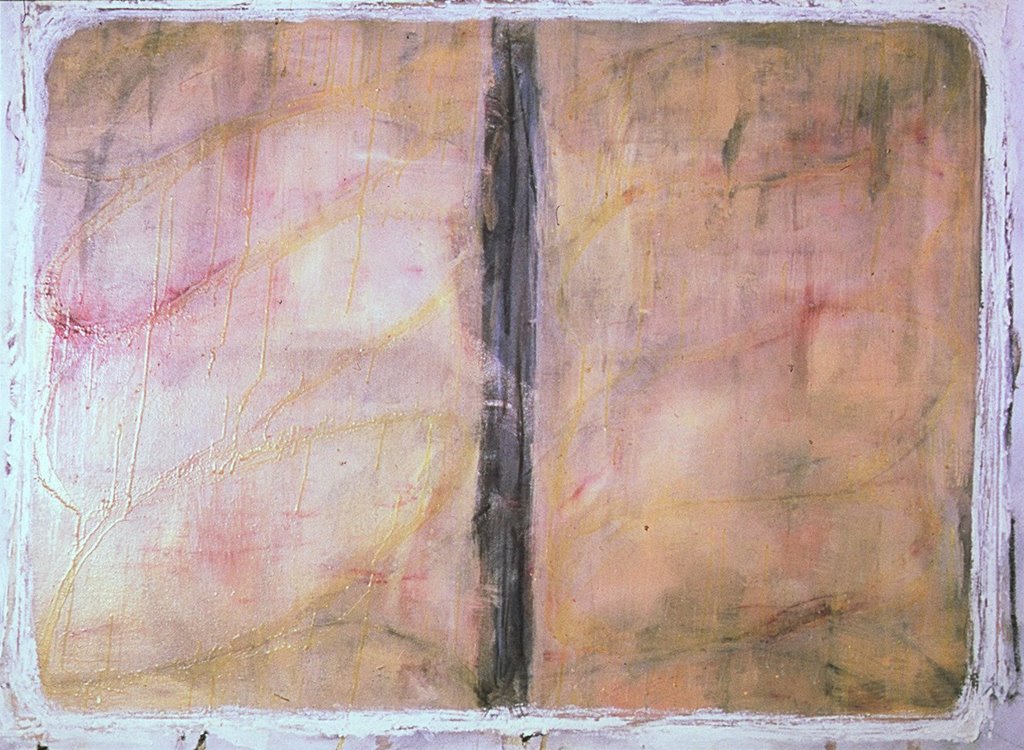
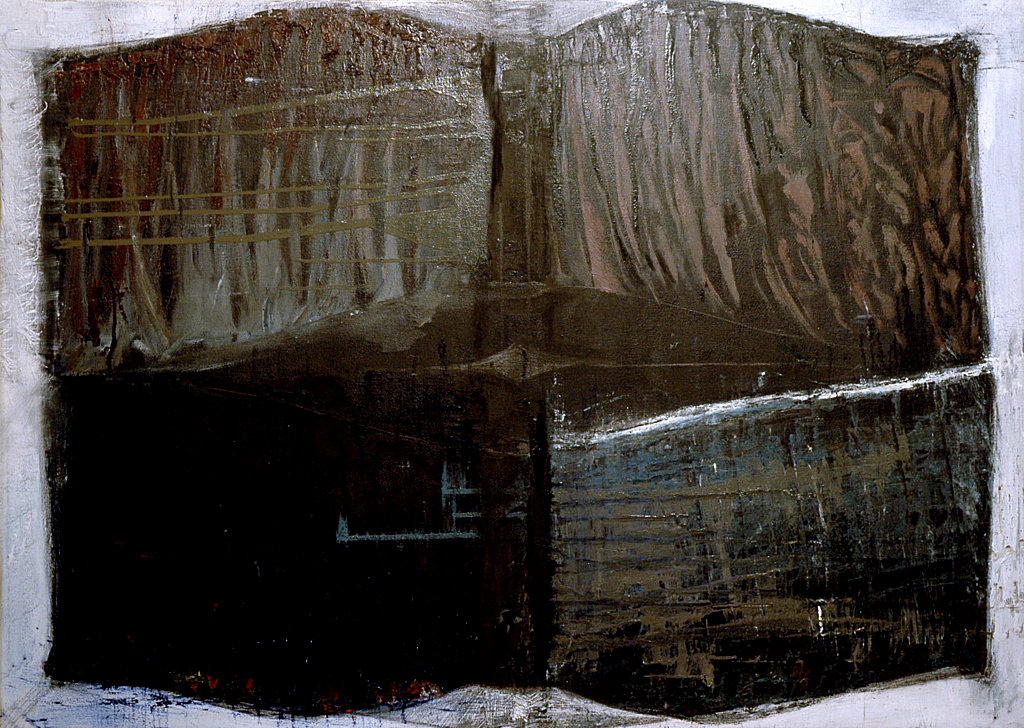


[This essay was written in April of 2011 for a forthcoming exhibition of Witvliet’s work in Holland. Exhibition details to be added as available. See Witvliet’s Website for images and text.]
I am painting a soldier in a desert, nameless. All what is identified is his nationality and his location (1.)
Growing up in the Eastern part of Gelderland, in Holland, Jeroen Witvliet used to look out over the fields along the Dutch-German border, a Kieferesque flatland riddled with little dips and incidents subdued by a general grey, weaponry half-buried (the wings and fuselage of a doomed Spitfire and Focke-Wulf in Paul Nash’s wartime Totes Meer) like the spontaneous gestures of action painters fallen to earth.
Anonymity and threat as indistinguishable forces that nonetheless compose a continuum analogous to ‘nature’ (whatever that is) are at the centre of Witvliet’s work. This is not a conventional nature, nor really a romantic wasteland awaiting restoration and renewal. If anything, it resembles the post-Eastern-Bloc terrain of the films of Andrei Tarkovsky, which Slavoj Zizek characterizes as, “wild vegetation overgrowing abandoned factories, concrete tunnels and railroads full of stagnant water,” suggesting that Tarkovsky’s wilderness is shadow to Western materialism, ‘the capitalist drive at rest:’
[…] nature and civilization overlap, but through a common decay – civilization in decay is again in the process of being reclaimed (not by idealized harmonious nature but) by Nature in its decomposition. The ultimate Tarkovskian landscape is that of humid nature, a river or pool close to some forest, full of the debris of human artefacts (old concrete blocks or slabs of rusting metal). The ultimate irony is that it was a director from the Communist East who displayed the greatest sensitivity to this obverse of the drive to produce and consume (2.)
Witvliet, who has adopted the West Coast of Canada as his home for over a decade, lives close by the rocky beaches of Swartz Bay, where he often observes the mingling of this decay firsthand in the form of tidal refuse: half-devoured wooden pallets, Styrofoam packing sheets and frayed and oxidized steel cable, strangely out of scale and in its utter abandonment (thrust higher than thought possible onto the shore by winter storms) seems not merely discarded but dispossessed.
His studio is a modest wood-framed outbuilding smelling strongly of linseed oil. It suggests an atmosphere segregated and preserved from the landscape around it, but coloured that same coastal grey, prone to those same ineluctable cycles or surges; a centre of gravity where things stir, albeit more slowly, at the behest of sustained concentration. The studio imposes its own duration and variability. It is a kind of history-making, if we think of history not as a traceable chain of cause and effect, but as a waiting game whose outcome is ever the accrual of substance; a hazardous mass negotiable only through the imposition of structure. Structure in painting is a business of testing: compositional models must be applied in a way that is blindly experiential. Looking at the dully gleaming, porous but obdurate surface of a gridded grey painting that fills one wall I think of Joyce’s Stephen Dedalus on the beach: “if you can put your five fingers through it, it is a gate, if not a door. Shut your eyes and see.”
The images are first of all subject to a general lay-out. Addressing if and if so at what stage in the editing process, the general lay-out of a page in the newspaper or on the canvas becomes superior to its content
The trial and error of composing a single painting is a weighing of the internalized histories of painting in general. I recently thought of Witvliet’s pictures when I read Jeff Wall’s explanation of his 1978 photographic work, The Destroyed Room. The image was based on the compositional construction of Eugène Delacroix’s The Death of Sardanapalus (1827), which depicts the Assyrian monarch on his deathbed, commanding the destruction of his possessions and slaughter of his concubines in a last act of defiance against invading armies (3.) Wall’s image, clearly staged (“Through the door you can see that it’s only a set held up by supports, that this is not a real space, this is no-one’s house”) was influenced in part by the contemporary prevalence of the emergent punk-rock aesthetic in fashion-window decoration. The compositional rhythms of Delacroix’s original (the stern tyrant as blocked-in in geometric profile as a kind of bracketing rejoinder to the undulating swoops and humps of concubines and killers, the reflection of a scared horse head in the man-shaped vacuum of negative space that seems to attack all sound) echoed by dumb, distended objects in Wall’s room, also transmit their lavishly fulsome combination of sex & death via the proxy of punk as transgressive advertisement. Compositional tropes have residual memory for painters who learn primarily by watching paintings as opposed to looking at them, a spectator of an event whose duration is both the immediate compositional narrative – the layout- and the pentimenti of its progenitors.
I focus on the safeguards we throw up when ‘looking’ at the barrage of images, on our choices or inability to concentrate on the lives behind the stories when we are exposed to a flood of visual news-media information
For Witvliet, painting’s self-reflexive character is a safeguard and a means of access, door and gate. This is why the resolution to declare the greater composition (the gestalt of the picture, the ‘layout’) comes inevitably at the expense of the individual figure: The Unknown Soldier, the faceless insurgent, the statue viewed in silhouette, the ubiquitous victim. Wittvliet is critical of the media’s distancing ‘safeguards’, the way images are controlled and edited to establish values, but participates in this same control himself, but only after a process of painterly inquiry has complicated things:
A girl being rushed into a hospital, her hands covered in blood, frightened. Normally I would read the captioning and move on. Now, however I spend more time with her. I am painting her hair and it is then that I realize that not too long ago, maybe hours before the ‘event’ her mother might have braided this thick, black hair.
It’s tempting to view this process in redemptive terms as the declaration of ground through sacrifice, as in the formula Heidegger lays out in “On the Making of a Work of Art”, in which “truth establishes itself as a strife within a being that is to be brought forth in such a way that the conflict opens up in this being, that is, this being is itself brought into the rift-design. The rift-design is the drawing together, into a unity, of sketch and basic idea, breach and outline.” (4.) Violence – aligned along a series of breaks with representation – in Witvliet’s work is an attempt to uncouple himself from the process of alienation that has first rendered subjects anonymous. Their reconstitution as painterly facts presents us with the evidence of that violence memorialized within a serial dialogue of painting’s matters (both the matter it resembles and the matter of its history.)
This is one way to consider the role of ‘ground’ in Witvliet’s work, as his consistent use of Abstract-Expressionist-style invocations of painting’s flatness and horizontality (the drip, the splatter, the pour, the scrape) in assertive counterpoint to the will to render via illustrative line, depictive modelling and deliberate relief. But there are other problems.
Recently, the artist and I discussed the challenge of painting a riot scene without resorting to painterly clichés, a challenge that dates back tellingly to the secular mayhem of David’s Tennis Court Oath and Goya’s Disasters of War. In a mob, there is no divine order, no ladder of angels with which to organize one’s position. As anyone who has ever been part of a mob will tell you, there is no certainty about which side you’re on. In Witvliet’s time, we cannot take a common domain of history for granted in even the most fundamental ways. And this applies to both artworks and historical narrative. And of course this applies to art’s most conspicuous history (its history of representation). As Jean Baudrillard said, drawing from Walter Benjamin, “you can never really go back to the source [of an artwork], you can never interrogate an event, a character, a discourse about its degree in original reality.”(5.)
Without a domain of history, memory is unreliable, peripatetic, decomposing and recomposing itself within disposable frameworks of referential topography. Belgian painter Luc Tuymans characterizes the outcome of this refuse-history as a revenant, a nagging sense of spiritual deja vue that aligns itself with the memorializing faculties of oil paint:
Pictures, if they are to have effect, must have tremendous intensity of silence, a filled silence or void. The viewer should become motionless before the picture [and] freeze [in] a kind of picture terror. […] The effect they should have on the viewer resembles an assault that he or she does not experience directly, but from a distance, initially. When he or she comes closer, this assault should loom again, but on a different level. Something quite unmistakeable then triggers certain emotions, makes certain demands. This can only come about in a certain silence [like] the silence before a storm. It is not about developing feelings of melancholy, but about a certain form of déjà vu…everything could be painting…or, in fact, everything is painting. (6.)
Tuyman’s distinction between a first and second ‘assault’ is a movement from one kind of apprehension and unknowing to another, should be familiar to anyone who has turned away from stories of catastrophe on the news and tried to reason with them either fundamentally (as an individual) or historically (as part of a self-identified community, citizenry or nationality.) Zizek invokes, for instance, the holocaust as both remote myth and untenable reality:
Here, however, are we not confusing two different modalities of trauma that is impossible to integrate into our symbolic universe: the fantasmic narrative of a special event that ‘did not really happen’ (like the Freudian myth of the primordial patricide) and the traces of an event that definitely did happen, but was too traumatic to be integrated into historical memory (like the Holocaust) so that we cannot register it as neutral, ‘objective’ observers, and accept it as part of our (past) reality. (7.)
Moving back and forth from myth to historical (un)reality, we leave a trail of misapprehensions and vexations, like the snail’s trail that Francis Bacon felt his figures traced within the void of his blackest backgrounds. Paint’s ability to shift from terrains vagues to figuration, from glancing film to durable skin (to paraphrase John Cage on Jasper Johns, a surface both naked and self-concealing) is what makes it possible to dwell on both possibilities simultaneously: the horror that the worst might be true and the realization that everything (identity, care, memory, values) will continue inevitably – mythically- just the same.
Painting these people doesn’t give me more knowledge about them. However in the process of painting I start to see them as less abstract. I can no longer see them as disconnected entities, but start seeing them as some ones farther, mother, daughter, son.
Intimacy is produced in the act of transcription and translation. This is never a sure process for painter or other participants, all of whom share some responsibility in the work’s outcome, acknowledging that widening clearing as after all the exhibition space rather than the studio. Hakim Bey coined the term “Temporary Autonomous Zone”, to define the space in which the body can still regard itself as a free entity in an age that spiritualizes the traffic of information at the expense of the body’s more rudimentary duration, compass and ceiling:
Every “fact” takes different meanings as we run it through our dialectical prism and study its gleam and shadows. The fact is never inert or neutral, but it can be both good and evil (or beyond them) in countless variations and combinations. We, finally are the artists of this immeasurable discourse. We create values. We do this because we are alive. (8.)
Here I’m reminded of Witvliet’s architectural sites with their insistent motifs of making and unmaking history: the multi-sectioned supports as if erecting the image (of a tear-down), the anti-monuments of unknown statue and persistent corpse; the Cartesian split between perspectival tunnel and horizontal matrix an insistence on the past’s ruthless access to the onrush of present and future as singular, simultaneous tense.
NOTES
Barrie Szekely: YardSquare
[Written for the Slide Room Gallery, March 2011. In its published form, the last sentence (pertaining to Anne Carson) was omitted.]
“…what’s exciting to me is if I can just catch anything in this great mass that’s turning, turning around. You see, it’s a world apart from language, I mean, the way a real writer would use words.
[…] “I would like to use a child’s hiccups held far off like water dripping as a component of my frame.”
– Richard Tuttle (1.)
There is a sculpture by Alberto Giacometti called “The Palace at 4AM” that features a series of cryptic forms that look like the parings of known things: a bird skeleton, a spinal column, a chess piece, a ball tipping in a shallow elliptical groove like the gall bladder resting against its liver…Not as themselves but vestigial gestures, rinds curing in the night mind’s swelter and chill. The palace might be an art museum, a treasure house of precious objects estranged from origins, gathered in greed, fiat & caprice, left alone to their histories in the dark of an abandoned castle of matchsticks. It might also be a birdhouse: wing-pinion, spine, organ and queen being more fluid or obdurate states of mind; thoughts in & out of flight.
The objects in Barrie Szekely’s paintings entail similar flip-sides of serviceable and mutable language: they are both facts that emerge into the conspicuous gloss of viewership and/or coordinates intuited in fugitive trace-making. Layered onto the wooden panels day by day, up against void (black ground) or open grain, they form into more stolidly actual pictorial propositions as they develop, but also, conversely (like mislaid names’ mnemonic tokens) less specifically accounted for as things in the world. Intimacy hovers like a tactile reprove; contingencies become paramount. Negative spaces enact unanticipated symmetries. Is that the hungry mouth of an empty glass or the flush, translucent bottom of a jar of jam? Usually something seems left out, as if an object had first acquired a reflection and then disappeared completely, its apparition (like an afterimage) lingering for a moment, a kind of backward salutation from the looking glass.
In Szekely’s studio, which also resembles a workroom, and also a garage, the wilted husk of a seed head sits on a bench waiting to be picked up and considered. After a time in that relatively dim locale it may lose its burden of task at hand and become a more or less ambient fixture between haphazard basement architecture and the behavioural & definitional perimeters of painting space. Consider the moral instruction of still life painting, the way it segregates personal, perceptual, and present-tense. W.H. Auden reminds us that it is not Keats who insists, “Truth is Beauty, beauty truth” but the urn itself (the poet just indicates that it’s what we know, and it’s enough.) Objects trained through the latticework of poetry know a life independent of perception; they are themselves. In Szekely’s paintings, this stubborn nowness is not a problem to overcome in making work; it is the primary condition for working. Working itself might be only another condition, for walking. (What is walking for?)
Rosalind Krauss has pointed out that the grid is the inevitable, self-concealing matrix of twentieth century art. Never seen before its advent, but afterwards, discovered again and again, and each time the artist “always taking it up as though he were just discovering it, as though the origin he had found by peeling back layer after layer of representation to come at last to this schematized reduction, this graph-paper ground, were his origin, and his finding it an act of originality.”(2.) But Krauss has also described the grid as, “a prison” in which the artist feels at liberty in searching for origins, but challenged in making something new from that beginning, in exercising that liberty, in adding more to what has already been said (3.)
The job of that freedom -to propose yard to studio, to tolerate and integrate shifts of scale and weather, to tether loose form to pattern, inhering call and response- necessitates a chronic absentmindedness. A tool is abandoned in one corner of the yard and its absence begins to weigh invisibly, inevitably elsewhere…Over several seasons, a pocket of oblivion forms, fallow and granular as a pillow cast from dirt. Thoughts in the house, the yard, the neighbourhood undergo gradual alchemical envelopment as indifference oxidizes, hatching pigmentations.
In his poem “Voyelles” Arthur Rimbaud famously gave each vowel a colour (“A black, E white, I red, U green, O blue”) conjuring a state of synaesthesia that also hinted at a chain of being from word to world – “I shall tell, one day, of your mysterious origins”- in which each letter conveys a terrain of evocation and animation (‘A’ for instance is black, “bright flies” and also “gulfs of shadow”.) (4.) These inventions as interventions are part of the morphological tug of Szekely’s peculiar creation, but they are not so much beginning as suspended, to be observed with a patience and practice that unites artist and materials, seed head to brush stroke. Habits of the mind, they are husbanded in what Anne Carson calls “Decreation”(5.), an undoing of continuity, a movement, not without desire, towards something less sentient.
Choice
[Originally published on Exhibit-V, February 2011.]
Referring to Debora Alana’s recent piece for Exhibit-V on Rebekah Johnson’s The Hamlet Panels, Christine Clark has commented, “Poor Hamlet.” That seems to be a good place to start. Why? Hamlet is one of those roles that consumes the actor’s personality, or insinuates itself in. Thinking of Daniel Day Lewis on stage frothing & neurotic, or Mel Gibson’s jocular striving to show himself to be both robustly and pragmatically insane, or my old favourite Lawrence Olivier, absorbed, withdrawn, narcissistic but tender (in response to what? To whom? To the form of the play, to the script. His tenderness is almost John Cage-ian in its withdrawn, abstracted amorousness for passage.)
Why this aside? The role is famous for connecting player to part to play to form. It is acting about acting in a play about plays (literally the theatre Hamlet creates within the play but also his own “antic disposition”.) That is important to notice here because the piece that RJ has made references Minimalism, specifically (in the statement) Donald Judd’s ‘specific objects’, for instance. Now the old debate about Minimalism (esp applicable – or at least the fight worth fighting- in the case of Judd), is Michael Fried’s “Art and Objecthood” in which Fried argues that Minimalism engenders a theatre for itself…a theatre of viewer response, self-consciousness and action. This is a problem for Fried, who argues that ‘absorption’(a kind of self-forgetting) is a key experience in western art. Minimalism, with its call to action, its theatre of the literal, disrupts this contemplation, spectacularizing itself in a way that becomes a didactic object lesson. OK.
Now, the problem (meaning the knotty problem, the interest, the tension) in The Hamlet Panels is that it is a theatre itself. A theater about Minimal form and its concomitant action…the surveillance cameras record your responses. A second clue is the floating ‘X’, like a patch of gaffer’s tape marking a spot for an actor in rehearsal, insinuated into the glass sandwich which is the the small zone, the puppet theatre if you like, for real viewer interaction in the piece. Caught between absence-presence-x-marks-the-spot and the cameras trolling, self-consciousness becomes self-surveillance. Obvious enough but keep it in mind.
Now we are quite acclimated to self-surveillance, as it has become pretty much a social form online in ways that pursue the courtly mirror-world of Hamlet. It is an adolescent environment, and Hamlet, though thirty, is an adolescent character, which explains why some playwrights despise him and modernists adore him. Moderns also love him because as a neurotic non-decider, Hamlet’s diffidence between problem and action becomes action itself, an interstitial zone that is rhetorically dynamic but practically static, indicating the importance of the courtly mechanism, the mechanism of the play and Hamlet’s playing as pivotal within it.
I want to argue that self-surveillance inherits this trope, that social networking for instance with its passion for text and mechanism and prurient curiosity for exposure and echo is very much the fit to this glove. It is important that Johnson’s not-quite-Minimalism-as-theatre-of-Minimalism has plenty of open ends when thought of this way…the absolutist qualities of many minimal forms as something we now accept as part of designed environments, both real and virtual for instance, reminding us that the big Hamlet-gambit of ‘specific objects’ (that the Minimal object is non-relational, anti-Cartesian, irrational in its insistence on unity rather than a compromising interplay of parts) has long since been absorbed into the current state of virtual environments as theory, but that as practice, having space ‘to stretch one’s arms again’ (as Rothko, pre-minimalist and dramaturge once said) is very important.
Thus the Fifty-Fifty for this show, thus (though I think it’s a weak point) so much loose swagging of cable around the site. Outside of the institutional habitat of the UVic Visual Arts department where this work was made (itself a nod to Judd, clarified) Johnson has shifted ground to surround her work with cameras and their cordage and the close walls of an artist run centre that has long made a name for itself as an ad-hoc venue. This is an authentic strength of the Fifty-Fifty at times, and a ranklesome irritant at others. Here it works, mostly. Knowing what we know, it would be great to see Johnson work with cameras again, and aim them more directly at the problem of lighting (attention that grants what Fried called presentness, grace) vs. surveillance (attention that implicates and frames), and all this vis a vis the question (thinking of Viola’s Room for St. John of the Cross) of connecting or divorcing the space.
[This essay was originally commissioned to accompany Tyler Hodgins’ installation, “Who’s Afraid of Red Yellow and Blue?” at the Stride Gallery, Calgary, in September of 2010.]
Afraid to Look
The title for this essay refers both to Barnett Newman’s 1966 painting “Who’s Afraid of Red, Yellow and Blue” and to painter Philip Taaffe’s 1985 riff on the same, entitled “We Are Not Afraid.” Taaffe’s painting can be interpreted as a semantic maneuvering of Newman’s colour field from its existential origin (itself a reaction to Mondrian’s equivocal, geometric composing) to another outcome: frankly plastic, positively ornamental, but not less serious for surrendering abstract autonomy to decorative sociability. It is context that matters here, and the courage to shift the scale with which an iconic image is read from public to personal, even confessional that I would like to address to Tyler Hodgins’ choice of motifs and materials.
What exactly is being confessed? The ambivalence (not to say fear) inherent in Hodgins’ decision to offer his own colour blindness as an impetus to reading this work introduces several important questions. For one, the work potentially unites artist and viewer in perceptual uncertainty. As Hodgins’ piece progresses, its colours are potentially compromised, though just how thoroughly and at what rate remain variables. This slippage echoes the character of colour blindness itself, in many of its varieties scarcely detectible without testing. The confession is also an act of faith: the degradation of colour in Hodgins’ work sets in motion outcomes to which he himself would be challenged to bear reliable witness.
Hodgins’ personal history compounds this sense of confession. Raised in a Christian Science household, he may have regarded his imperfect vision as something to greet with silent circumspection; the mystery represented by a crayon whose label had worn away was a singularity of personal doubt. Later, in art school, it was secret by default. 1 Colour in this anecdote stands for faith, but is defined by its absence within a continuum of undermining uncertainty; an endless, worldly dust.
Sculptor Gabriel Orozco’s defines just such a “confrontation of colour and dust,” defining dust as both “a negative pigment” and a “totalitarian surface”:
…Everything that gets dusty just becomes surface […] Painting tries to create an illusion, the illusion of volume, perspective or light. It promises a kind of enlightenment through colour […] but dust is the contrary force. 2
Orozco cites the special case of public sculptures, whose default state, he sees as “abandoned to dust.” Hodgins’ practice engages an ongoing involvement with public sculpture projects, underscoring the monumentality of the column-like ‘zips’ of Who’s Afraid. But they also resemble both Pop quotations of Newman’s forms, or their revision as Minimalist sculpture, and in extending the metaphor of dust as a ‘totalitarian’ leveler, we might conceive of the entropy of dust as relatable to other kinds of entropy, such as the inevitable debasement of monuments as enlightening commons to commercial or industrial spaces, kitsch or cliché. 3
The complexities of these quotations have already been mapped somewhat by artists like Taaffe and Peter Halley, who used similar strategies to relate Newman’s zips to decorative/architectonic/technological schematics; not a purist platonic geometry, but, as Halley describes it, “the soft geometries of interstate highways, computers, and electronic entertainment.” 4
Likewise, Hodgins’ vacuum cleaners have a precedent in Jeff Koons’ readymade New Hoover Convertibles (1981-86). Thinking of Koons’ ‘vacuums’ or even Warhol’s ‘Brillo’ boxes, the metaphor seems obvious, that readymade culture is a killer hygiene, destroying all other seminal gestures of meaning. Halley writes that Koons’ perfect vacuums propose a world of model realities, “a state of asepsis and weightlessness.” 5 That Hodgins’ robot vacuums not only clean the sand but (through bumping the columns) trigger more spillage is important. They imagine the underside of the readymade’s spiritualized sheen as a polluting of perception, a totalitarian leveling of the value of visible labour.
It is significant that invisible labour via institutional care completes the cycle of Hodgins’ work: the behind-the-scenes activity of gallery workers emptying vacuum cleaners back into the column-tubes at day’s end. It should be said though, that the work is not so much completed as protracted… The time it takes for hollow columns to retreat from their initial interactive vibrancy to become greyer, more obdurate things is impossible to measure, a collapsible eternity. Ultimately what makes ‘us’ Who’s Afraid is a more subtle, moral entropy, our own inability to track and discern with care over time. As Paul Valéry remarked, “It is almost as if the decline of the idea of eternity coincided with the increased aversion to sustained effort.” As every compulsive gambler knows, observing the operations of chance too closely for too long engenders a fatigue with the concept of destiny. Like the retinal fatigue that dismays Newman’s painted zips with juddering afterimages, attempts to track the serial overlap of Hodgins’ colours do not reveal their subject so much as dismay it, carrying our attraction to further and further back toward an increasingly unstable instance of material cause. Like Newman at his most integral, Hodgins is interested in marking a human scale, albeit one in time rather than space.
Endnotes
1. Conversation with the artist, August 28th, 2010.
2. Gabriel Orozco, “Gabriel Orozco in Conversation with Benjamin H.D. Buchloh (2004)” translated by Eileen Brockbank, October Files 9 Gabriel Orozco, Edited by Yve-Alain Bois (Cambridge: MIT, 2009) 114.
3. Yve-Alain Bois makes this equivocation in addressing the use of cliché in Edward Ruscha’s work, comparing the latter’s trompe l’oeil melting letters to the entropic undoing of articulation – both physical and semantic- in Ruscha’s use of ‘pop’ language. C.f. “Liquid Words,” Formless A User’s Guide, with Rosalind E. Krauss (New York: Zone Books, 1997) 124-129
4. Peter Halley, “The Crisis in Geometry,” Arts Magazine (New York, Vol. 58, No. 10, June 1984) http://www.peterhalley.com/.
5. Halley
6. Quoted in Walter Benjamin, “The Storyteller,” Illuminations, translated by Harry Zohn (New York: Schocken books, 1968) 93
“Visceral Bodies” at the Vancouver Art Gallery
[This review was written for Exhibit-V and posted April 29th, 2010. It has been edited slightly from its original form, mostly to eliminate redundancies in language and argument. ]
Part of the Cultural Olympiad, the exhibition Visceral Bodies at the Vancouver Art Gallery (curated by Chief Curator/ VAG Associate Director Daina Augaitis) is presented in dialogue with the accompanying show of Leonardo da Vinci’s anatomical studies, The Mechanics of Man. Visceral Bodies is itself divided into three sections, “Visceral Bodies”, “The Scientific Body” and “The Fragmented Body”, invoking both hard and social sciences, or as Gallery director Kathleen Bartels put it, “the body as a subject of anatomical, social and psychological study.” Strange bedfellows with skytrain station advertisements displaying the sleekly x-rayed physiques of athletes in motion (faster without their skin on), the notion of the paired exhibitions is to present Leonardo’s sketches -taboo-transgressing scientific humanism – alongside a more radical inquiry in which ‘humanism’ as such may not survive the procedure by which the taboo is excised.
At the entrance to the gallery containing “The Fragmented Body” is a collage by Kenyan-born, New-York based artist Wangetchi Mutu, I belong to you, you belong to me (2007.) Gracefully negotiating attraction and repulsion, smooth skin cut from advertising and illustration presents a soulfully luxurious tension that is ruptured by clutches of plastic pearls that spall incomprehensibly, uncomprehendingly out of unexpected orifices. Skin as such (and our gaze skimming it, drawing pleasure) becomes inadequate to cover what lies beneath (an interior decomposition, or more threateningly, like an expanding universe or spawn of maggots, recomposition.)
Mutu’s materials are at one with her content: Mylar (the synthetic cousin of vellum, calfskin) feels like skin and is manufactured for drafting; craft store ‘pearls’ are at once both agitating grains and corrosive kitsch. Everything frightening in its natural manifestation has its synthetic echo and all of it cajoles, upsets, and ultimately objectifies our involvement. It seems too obvious to say that Mutu’s imagery speaks to gender or race (in another gallery, we see more collages made from old medical illustrations of sexual organs infected with disease), or rather of one race or gender’s view of another exclusively. They are the fear of multiplicitous categories, of mutation, loss of resolution’s dignity and segregating language. They are powerful because they acknowledge that desire undoes these things as readily as disgust or dread.
Other works in this gallery are not as strong. Shelagh Keeley’s Writing on the Body (1988), is a massive multi-panel wall piece consisting of drawing as deliberately crude atavistic/confessional sign systems referencing bodily fluid, internal organs and amputated /alienated body parts. It was originally a site specific piece, in which the artist covered the walls of a gallery in Tokyo with a mixture of wax, Vaseline, and pigment. Here the panels have been cut out of their original architectural environment and propped against the wall, appearing as matter-of-fact slabs mostly absent of tension; the space the bodies would seek to assemble themselves in cannot thicken around them or attenuate threateningly.
This point is underscored by a small row of drawings on vellum by Betty Goodwin on the opposite wall. The Goodwins are taut by comparison; merciless in their ability to marshal stray swipes of carbon into a deft, dramatic economy. Positioning these two bodies of work across the gallery from one another robs each of something important. Keeley’s work looks like poorly informed illustration when it means after all to appeal directly rather than portray; the terse mythopoeia of Goodwin’s drawings get crowded out by a much larger work that seems to extrovert and vulgarize its palette and technique. It’s a superficial comparison.
Overall, it has to be said, that the gallery would benefit greatly from some judicious editing. The overwhelmingly sensuous affect of works as varied as a papier-mâché skin by Kiki Smith and a video of several sonorous larynxes by VALIE EXPORT would have more impact in an evacuated, clinical environment, the lucid surveillance of a contemporary art space merging with the sterile caution of the care facility.
Perhaps the only work that makes a virtue of the crowding is a haunting sound piece by Teresa Margolles called Sonido de la Morgue/Sounds of the Morgue (2003). A pair of heavily insulated headphones hanging from the ceiling in a corner proffers listeners the sound of an autopsy being conducted on an anonymous murder victim in Guadalajara, Mexico.
The sounds are mostly a continuous, slushy slicing and sawing remarkable for both its professional efficiency and its homogeneity. I am reminded immediately of the seemingly endless string of unsolved murders in Sonora County, excoriatingly documented in Roberto Bolaño’s novel 2666, and like that narrative, the relentlessness of the situation is by turns both horrifying and giddily absurd.
In a crowded space the sound becomes gravely intimate, the grim reaper sharpening his scythe heard as cricket legs rasping together on the fringe of your hearing. It almost feels consoling to note its persistence as one strives to shut out other sounds, feeling the relief that the worst is after all over and the procedure carries on unhurried. It’s only when one tries to have an interior monologue in response, that the continuity of the sound becomes gratingly intrusive, demarcating a boundary between internal and external, and interupting the predatory progress of expectation as development. Death is distracted.
The next section, “The Scientific Body”, suffers from overcrowding, but in a way that more directly undermines the operation of some of the artworks. Notably, works by Gabriel de la Mora and Mona Hatoum propose the artist as manipulator of medical imaging, and rely on a place for the viewer’s body to relate directly to this imagery so as to be implicated in its projected diagnostics.
Mona Hatoum’s Deep Throat (1996) presents a blandly innocent dining table and chairs, with a screen neatly inserted on the bottom of a dinner plate. The screen shows a video of an endoscopic exploration of the artist’s digestive tract. The title of this work calls up the famed pornographic film of the same name, with its overlapping associations of eating, speech, and sexual penetration. The arrangement also suggests an homage to the work of surrealist René Magritte, notably Portrait, 1935 (a slice of ham on a plate that stares out at the viewer from an unblinking eye) and The Rape, 1934 (a face whose naïve features are a woman’s nude torso.) The implication is of sexuality without intimacy, but more properly of a body alienated from itself. Like the victim of an eating disorder or childhood abuse, the self of Deep Throat has lost the horizon upon which to envision the negotiation of its thresholds. Paradoxically (and pathologically), nothing can be controlled but everything shall be witnessed.
The problem with the presentation of Deep Throat here is that the room is too crowded to approach the table at some remove, as ordinary domestic tableaux. As a result, the initial sting of bourgeois betrayal is lost. Likewise, the chair is barred from sitting with both conspicuous plastic strapping and a large sign. This seems like museum security overkill, and disrupts the fantasy that it is the viewer who is invited to sit and stare, and by extension, weakens the implication that the abyss we gaze into represents our own internal workings.
Likewise, Mexican artist Gabriel de la Mora’s Memoria I (2007) wants to make a space for the viewer as participant. Using MRI technology and a 3D printer, the artist produced seventeen replica skulls based on those of his close family from both live and posthumous scans. These include the skulls of a stillborn sister and deceased father, all placed at their owner’s respective height with the exception of the tiny infant, who appears as if cradled at chest level. As a memento mori or vanitas (reminder of death’s inevitability), the piece is compellingly direct, yet also delicately tactful. At a distance, the synthetic skulls emerge only gradually from the background wall, calling forth their idiosyncrasies and differences as they do so. Up close their appeal becomes more immediate and irresistible, their evident fabrication hinting at both material and virtual presences; now, elsewhere, and later all at once. In a tight space, this transformation is not enabled, and the pieces can too readily be taken up as ethnological curiosity -Day of the Dead carnival-, their mirroring potential passed over (It’s worth noting that this is one of those pieces that rewards, or even anticipates the gap between online purview and firsthand encounter) .
In the end, it is not really only a question of curtailing or choreographing certain works to a greater or lesser degree. The more important issue is how the various works come together, and it is here the charge of crowding becomes most detrimental. Having two works each by Wim Delvoye and Marc Quinn, for example, means that each piece by a given artist, though distinct formally and conceptually, has more obvious similarities with its sibling than with other pieces in the exhibition, so that the artist’s brand is more strongly enforced than thematic links from work to work across disparate disciplines and milieu. Of two sculptures made by Berlinde de Bruyckere, one maintains a delicate balance of sacred and profane grotesquerie while another is less subtle, weaker in placement and ultimately supplementary.
In some cases, artists should have been reconsidered, relocated or not included at all. The exoticism of David Altmejd’s work feels generally ill-supported and out of context in the midst of its more somber neighbors. Antony Gormley’s Drift II (2009) accomplishes itself brilliantly in a room of its own while Luanne Martineau’s provocative Dangler (2008), stuffed into a corner by a doorway, is hard put live up to its name. Martineau’s felted sculpture has fantastic but complex presence, much subtler in reality than in reproduction, and this is part of its tactile/semantic undertow. To deny the work its softer operations is, significantly, to curtail the viewer’s progress through the hazards and liberties of critical reading.
Visceral Bodies suffers from organizational problems that obscure both the power of individual artworks and the greater gesture of curatorial intent. I hope it does not sound like post-Olympic grousing to state that the challenge faced by the proposition of Visceral Bodies are a problem of curating as commuting meaning versus programming as engendering spectacle. The body is a potent frame of reference when come upon unexpectedly, offering both the informational shock of the facts of life and the contemplative unpeeling of their artefactual presence. To repeat this revelatory act of skinning the cat so many ways in such close quarters however, is to risk robbing mimesis and allusion of their power to transform in any lasting way, which is to say, within the body of the viewer’s sensibility. Denied sensibility, the works must become bodies without politics.
 John Luna