As part of the 10th Anniversary of the Vancouver Island School of Art, my work – along with Wendy Welch and Xane St, Phillip- is featured in the Founder’s Exhibition at the Slide Room Gallery, from January 16th to February 16th, 2015.
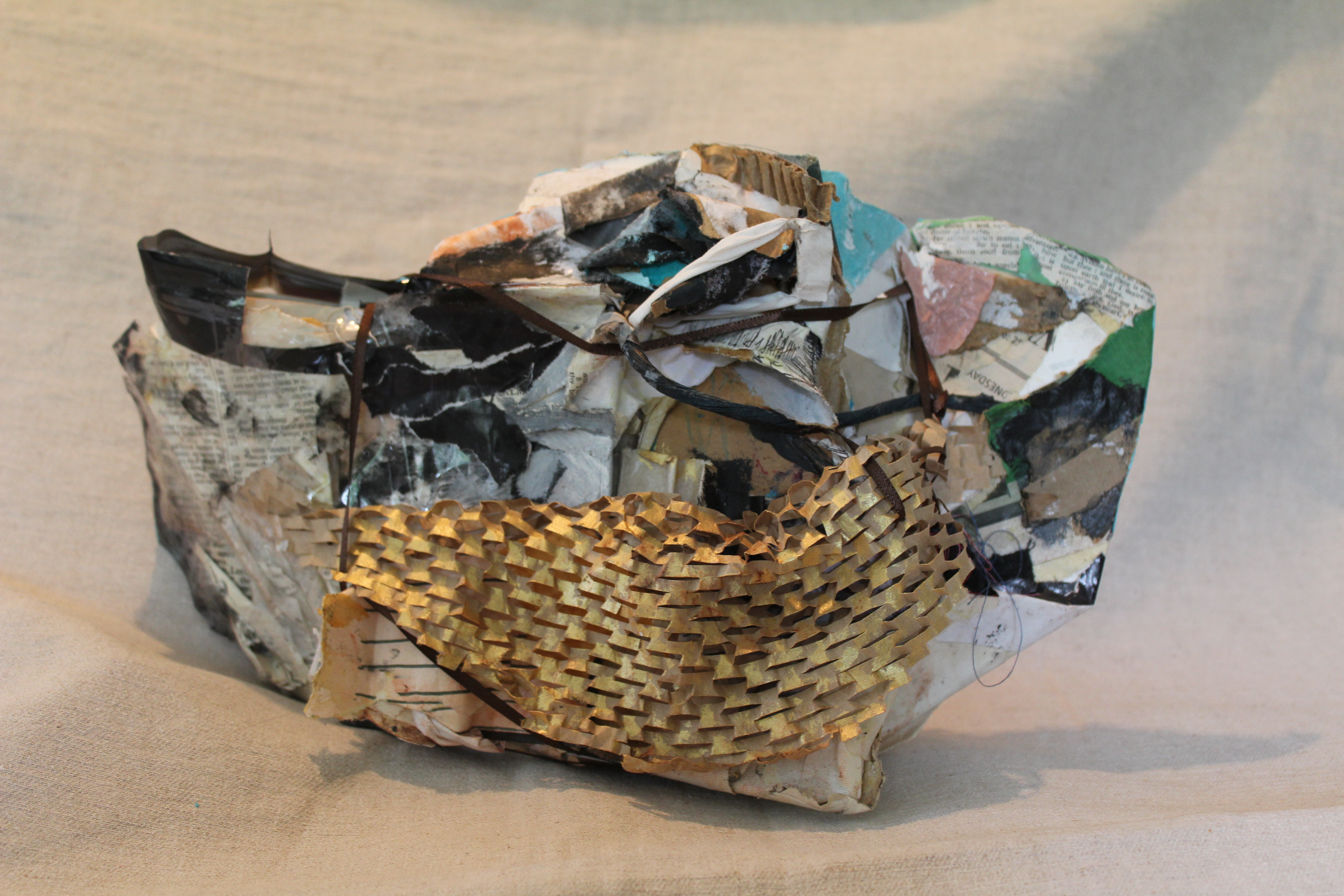
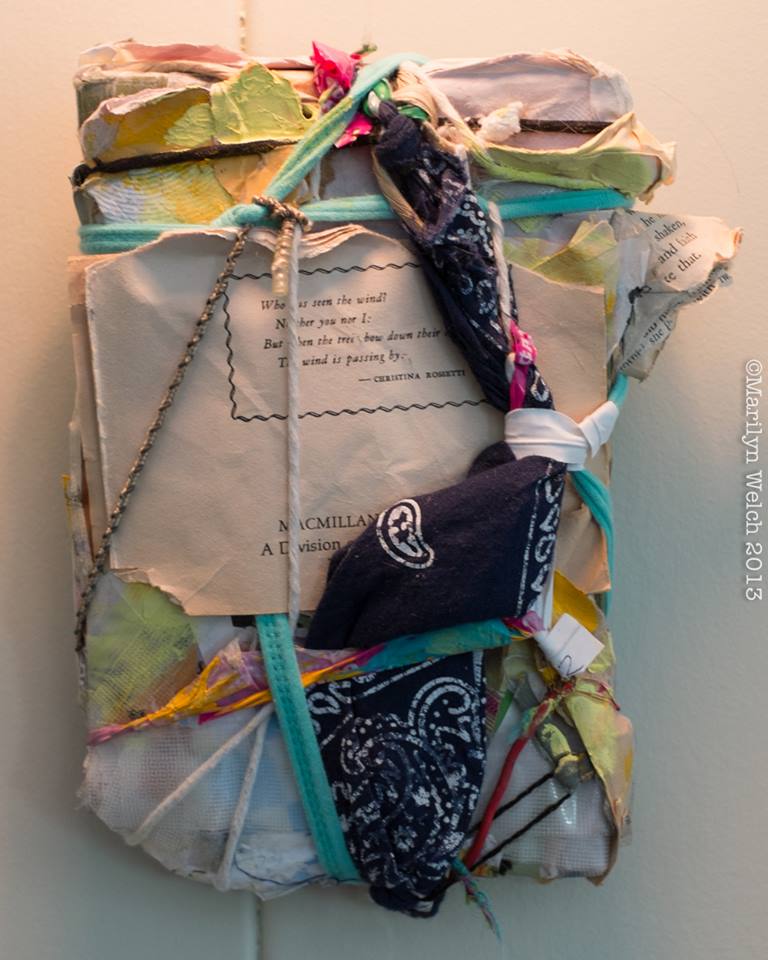
As part of the 10th Anniversary of the Vancouver Island School of Art, my work – along with Wendy Welch and Xane St, Phillip- is featured in the Founder’s Exhibition at the Slide Room Gallery, from January 16th to February 16th, 2015.
This essay was written for Xane St. Phillip’s exhibition, Paradise Lost, at the Slide Room Gallery (May23rd-June 2nd, 2014.)
Though originally intended for a catalogue, this is the only publication of the essay to date.
Xane St. Phillip, “Paradise Lost”
“White and Greens in Blues was a culmination of the inner seasons, just as at times it is not the passage of a swift dawn or a prolonged sunset that is so deeply stirring, but it’s palpability: the concretion of flux.”
– James Schuyler[1]
“White paint is my marble,”
– Cy Twombly[2]
How do we begin to talk about sensation? When we first speak to share our awareness of the changing temperature or an unexpected flavour, or cry out in alarm, or swear in agitation (and all of these things might register both pleasure and pain) to define hot or cold, sour or sweet, damp or dry, we are social animals; trying to fix between ourselves and others a borderland between exterior and interior experience, a shared skin. Colour is a comprehensive language that allows this exchange to find its middle ground, a shared domain that, while certain – unless one is colour blind a red light is red, not green – is also variable in affect (is that red invigorating or angry?)
Artists, negotiate colours partly through theory, red read as complementary or analogous, saturated or neutralized, but also pigments: Cadmium Red or Venetian Red or Alizarin Crimson, each one a distinct entity. Burnt Sienna, a low-intensity orange-brown the colour of cordovan leather, is cooked Siennese dirt, rust-coloured because of iron oxide. Thus, on a chemical level, colour is alchemy. The analogy holds up for our understanding colour theory too. Just as we are scarcely aware of a sensation before conveying it to others, so too we hardly begin to describe a colour without relating it to other colours and perceptions of colour in an endless feedback loop. Colour as an idea in the eye of the beholder, but in the mouth and index finger too: promiscuous, jealous, various, collusive, infinite, resilient and never wrong.
Xane St. Phillip’s “Paradise Lost” is about specific sensations – warm, cool, closed, open – but also about what sensation itself is, or (in keeping with the title’s elegiac tone) the gap between sensing and saying. Perhaps the most poignant examples of this gap come via images of stars.
One of two floor pieces in the gallery uses a pattern of interlocking eight-pointed stars of the kind frequently featured in mosque-decoration. St. Phillip crafts this image using black linoleum tiles, a connection to the exhibition space’s history as a schoolhouse (the gallery floor is composed of the same make of tile in a weary institutional greige.) In accordance with the Japanese principle of Nōtan, or ‘dark-light’, the graphic black pops the background flooring into sharp relief (I am reminded of critic David’s Sylvester’s characterization of Henri Matisse’s use of dark and light: “light flares out of the blackness.”[3]) The star-patterns shift from positive to negative in constant, symmetrical synergy.
Above, the ceiling’s similarly institutional acoustic tiles are also spangled with stars, these cut out of white mat board. In his artists’ talk, St. Phillip remarked that, given more time, they might better have been made of gold leaf, but I disagree: the mat board looks fresh, present tense and lean; he has used a framing material to make a drawing, reversing the roles of edge and center, punching holes of implied absence in the drop-down ceiling. The effect is at once both off-the-cuff and artisanal (St. Phillip worked for years as a professional framer), an urbane combination thematized throughout the whole of the show.
The gallery’s main window is veiled by a four panel, freehand “cut drawing” executed by VISA student Sarah Cowan. The pattern is an “inhabited vine,” a Roman motif featuring an arabesque line enlivened by animals, in this case birds and rabbits. During various hours of the day, arcing southern sunlight splashes vibrant colour through the cuts from the yard outside – unexpectedly from a graffiti mural on the side of a steel shipping container- whose lyricism, extracted and transfigured, glistens; pointillist daubs bobbing in sun-limned filaments. Cowan’s intuitive contours recall Matisse’s phrase, “drawing with scissors”, and the shifting light’s activation of colour into line echoes his scheme of window and wall decoration for the Chapelle du Rosaire at Vence, France, in which the glow of stained glass is carried to a drawing on the opposite wall. Here, there is the same combination of soft mutability and atmospheric power brought about by an economy of means, but with the intimation that the combination has been chanced upon, and that all (from the graffiti to the paper to the room itself) is provisional.
Other influences St. Phillip cites throughout the show include colour-theory pioneers Joseph Albers and Johannes Itten, along with architect/painter Le Corbusier (whose book, Le Poeme de l’angle droit, was propped by the east window during the opening). These influences are evident in square, modular paintings, whose wooden supports are St. Phillip’s tribute to the beveled tongue-in-groove paneling that lines three of the gallery’s four walls. The grooves become borders for dividing planes of colour selected from the Colour-Aid System, the designer’s tool that Albers himself used with students. Of the varying tones and temperatures, St. Phillip says, “I tried to have neutrality and temperature and value all in balance in these pieces…every one tells a different story.”[4]
Minimalist in spirit, the wall pieces reward close scrutiny, though scanning them is literally staring at a wall. Density and duration add hidden weight to the matrix of the curt, closed squares via the application of colour to surface; some of the boards were painted in a dozen layers to achieve the right look, while others were touched only twice. The architectural character of the works becomes more focused when each piece is viewed as an experience unto itself, as if a colour palette for an imaginary interior. Viewed this way, each becomes like a still-life painting with almost nothing in it, revealing the real substance of still life: light and shadow, stasis and transformation, palpable presence or conspicuous absence.
The way in which the gallery’s vertical lines become a rhythmic substructure for the wall pieces has the effect of sharpening the border between work and wall, as if reminding viewers of the here-and-now-ness of experience in the specifics of surface, support, texture and pigment. This argument is curiously reversed on the south wall, where a diptych of canvasses painted in soft blues seems to melt into an even paler blue alcove.
Playing to the space, St. Phillip has chosen the one perfectly smooth half-wall of the gallery to mount a conspicuously painterly piece. Five hues of blue pigment have been scumbled, dragged, rubbed on, pulled off, plied with turpentine burns and basted with wet-into-wet glazing, resulting in a surface that while purportedly not ‘about’ water nonetheless recalls both the diaphanous transitions and dense, gestural confectionary of Monet’s Nympheas. The bold move to mount the diptych on a blue wall floats its tensions in a pool of coolness that seems to suspend it conceptually as well as pictorially.
Does an abstract painting lose its expressive integrity when threatened by a literal comparison to landscape, or, does its history of marks become only so much decoration when its colours are ‘too beautiful’? These problems have been explored before with care, by another St. Phillip’s influence, Richard Diebenkorn, notably in his well-known series, Ocean Park. A more contemporary struggle St. Phillip understands is the inescapability of the quotation marks we now place around abstract painting itself (he often points out that many students do not learn to make abstract paintings, but only copies of other abstract painters’ work.) The blind of the blue wall is a kind of patient parentheses that displaces the object-hood of the painting in an imagined space apart. The effect is theatrical but also absorbing, the split of the diptych hinting at a seam in the curtain, impenetrably imperturbable.
In the same way, a nearby orange canvas offers punctuation chased with relief. The west wall, clad in horizontal boards, is painted along its surfaces, gaps and crevices in mauve, pink and turquoise, respectively, all sharing the same value, with resulting subtle discords and contrasts. The unsettling physical twinge associated with discord colour combinations is the result of upending the mind’s expectations that purple must always be dark or orange always pale, when darkness necessarily conveys heaviness and pallor lightness. Like orange desert rocks against a cobalt sky, or the wan violets and greens of Aurora Borealis, discords often feel transportive and weightless. The bold, glazed oranges of St. Phillip’s minimal square act as both charger and foil to the wall’s split differences: orange supports pink and opposes turquoise, electrifying the gaps between boards; at the same time, the flat, matter-of-factness of tinted canvas offers – as the artist has remarked – a relatively static ground for the eye. A small scuff mark in the corner of the orange (the canvas was primed outside and picked up dirt) settles the orange as picture like a signature.
Orange and mauve are situated on the colour wheel on either side of red, the absent presence that, according to the artist, colours much of the exhibition. In Matisse’s famous painting, Red Studio (1911), the entire space seems to have been flooded in a hue the tone and temperature of blood. Matisse picked up this red from the murals of the Villa of the Mysteries at Pompeii, a source that has inspired painters – from Jacques-Louis David to Mark Rothko – since its excavation in the 18th century. Matisse’s painting presents a concrete thesis on the convivial flux uniting nature and culture: a small statue of a nude stands in for a resting body, plants echo the contours of patterns; the clock has no hands, and everything is transparent that is not quickened by life or art.
Settled into a niche in the St. Phillip’s mauve wall is a small, six-pointed star rendered from black floral wire. St. Phillip dedicated the show to artist friend Rachel Berman, who passed away the week the show opened. As a counterweight to the orange canvas, it is a frail token of mortality, an Et in Arcadia Ego whose elegiac character is also present in the exhibition’s most obvious nod to history (as well as its most aggressive architectural intervention). A double-row of columns lead from the space close by the memorial niche, and gallery entry to an open door leading outside to a cement basketball court and, beyond that, a grassy field. The millwork surrounding the entry and exit doors is loosely painted a soft hospital green.
The columns are simple structures composed of flat millwork that has been whitewashed and gently stenciled with a stylized cypress tree motif. They are in part a cunning solution to a difficult installation space, as one of the columns masks a structural support stud; the others are there for rhythm and symmetry (St. Phillip, a stickler for proportion, once designed a studio based on Palladian principles). This use of nature in quotation within a rigid geometry recalls the classicism of Le Notre’s gardens at the palace of Versailles, a reading complemented by another floor piece, a ‘reflecting pool’ of blue linoleum tiles based on an ancient Roman mosaic motif. Cypress-columns compose a kind of allée to lead the viewer outside, where one is confronted by an actual Italian cypress sapling, planted in the scrubby urban grass.
Whitewash (with its connotations of sanitizing ugly truths) has a long and varied history of bestowing, not only lightness to a surface, but purity, with the latter’s twin connotations of hygiene and separateness (white is cooler in a hot country; lime wash possesses antibacterial properties.) Here, whitewash is primer for an impressionistic mirage’s primitive rhythms. As heralds of an obscure past, they speak to the suspension of disbelief that the garden proposes, even as the rudimentary structural proposition of the allée disciplines the positioning of those passing through. This washed-out white is the formal echo to the white and shadows of Cowan’s cut window screens; both are votive scrims, softening or concealing reality while proffering virgin surfaces for archetypal devices.
Discussion at St. Phillip’s opening included questions about his choice of title, Paradise Lost; some thought it alluded to the role of artifice that allows the ordinary (a scuffed institutional floor, the creases between clapboards) to grow expansive in the imagination. David Sylvester writes about a cut-paper composition of a swimming pool by Matisse:
“…Volumes and space seem to switch roles with each other […] sometimes the blue areas seem to be the swimming or diving figures. Sometimes the figure seems to be the white and bare canvas contained within an open blue shape. Sometimes the blue shapes seem to oscillate between being figures or limbs and the empty spaces around and between being figures or limbs.”[5]
The formal oppositions with which St. Phillip interrelates artwork, colour and architecture ultimately reveal a locus of control that must make its peace with the graces and fallibilities of space, time and circumstance so evident in this venue. Along these lines, the exhibition title also recalls Ezra Pound’s rueful coda to his monumental address world literature, The Cantos:
I have tried to write Paradise
Do not move
Let the wind speak
that is paradise.
These lines are more complex than they first appear to be. The listener must stop, but the wind must move in order for it to speak; to, ‘let the wind speak’ is to momentarily subtract authority from poetry. But this silence is the reader’s also, who listens out of range of the interior call and response of Pound’s poetry. This gesture of self-abnegation is kin to the kind of immersion that colour-field painting has historically called on viewers to embrace as a means of achieving a bodiless, meditative state. But as a mandate for an exhibition, it is also willingness on the part of this artist to allow viewers the freedom to drift from interest to interest. St. Phillip’s casual care approximates an open-ended invitation concealing the efforts that have produced it, a gesture of hospitality reminiscent of the Arabic and Mediterranean cultures he candidly admires. It is also a kind of metaphysics of being at home in the world, an elevating of the elements and principles of design that unites with an elegant gesture the cosmetic with the ontological.
[1] James, Schuyler, “Mark Rothko”, ArtNews, 1958, reprinted in James Schuyler, Collected Art Writings, Santa Rosa: Black Sparrow Press, 1998.
[2] Qtd. In David Sylvester, “The White Originals/Cy Twombly the Sculpture”, Art In America, July 2000. http://www.cytwombly.info/twombly_writings2.htm
[3] David Sylvester, “Matisse”, from About Modern Art, Critical Essays, 1948-2000. London: Pimlico, 2002. P. 143.
[4] All quotes by St. Phillip are from his artist’s talk at the Slide Room Gallery, June 1st, 2014. https://www.youtube.com/watch?v=OPefBoZ7ezk
[5] Sylvester, p. 143.
The following review was written for Sandra Meigs’ exhibition, The Basement Panoramas, at Open Space Victoria (Nov 1st-Dec 14th, 2013). It was published by Canadian Art Magazine online.
At the Bottom of Everything
Sandra Meigs, The Basement Panoramas, at Open Space, Victoria
When Sandra Meigs met me at her exhibition of murals and accompanying installation work, The Basement Panoramas, and we ‘walked’ the paintings, twice I misheard her saying “breathing” as “grieving.” It was a telling mistake. The works are rooted in an immediate personal history: in January 2011, Meigs, who had recently married and purchased a home, lost her husband to cancer; during their final months together, she started to relate to the crawlspace and bedrock of the ninety-year-old house to mortality, a space removed from the traffic of waking life, yet, in the artist’s words, “containing time.”
The first of the murals, Red. 3011 Jackson. (Mortality), named for the address of the house, relates this evocative reckoning to the networks layering the crawlspace: ducts, wires, cables and fuses, redundant or functional, vestigial or retrofitted, surrounding and commuting the vortex-like swirls of the stony floor. The twenty-five foot long mural was composed of photos of the crawlspace taped together to form a panoramic view, from which a schematic rendering was derived for projection. The drawing’s contours look liberated in the radiant layers, supplying a bloodied lushness offset by Meigs’ neat parsing of constituents: a fuse box is “portal electrical”, an old five-panel door, the “door of mortal birth” and protruding bedrock a Wagnerian “universal realm.” The invocation of colour as transforming wavelength recalls Matisse’s iconic Red Studio (1911): a body-temperature continuum of fluidity and atmosphere, the objects within it (especially artworks) limned with light as if radiating significance. Meigs’ basement is a metacognitive space, a set of generative coordinates in which – as in Matisse’s clock face without hands – the explicit depiction of action (past-present-future) is withheld.
Mortality became the first of a series, and Meigs’ research for the pictures that followed undertook travel. Blue. 1000 Mountain Rest. (Breath) takes its architectural underpinnings from the Mohonk Mountain House, a massive Victorian-era castle resort in New York State with storied origins in Quaker-based pacifism. This retreat was, for Meigs, also something of a sojourn into prior work: for her 2009 series, Strange Loop, Meigs made trips to Newport, Rhode Island, and the Cooper Hewitt Museum in New York, visiting several examples of 19th century Shingle Style architecture. Meigs’ stripped renditions of these interiors simultaneously suggest the magical reality of children’s book illustration, and a labyrinthine tracery of cognitive routing: blank faces stationed on newel posts, coffers and risers in ceilings and staircases rolling along like conveyor belts; eyes and vortexes stare or suck.
Breath is based on the porte-cochere of the retreat, revised as a place of purgatorial procession. Meigs’ original drawing for the piece features figures composed almost entirely of faces seen in profile, pulpy caricatures reminiscent of Ensor or Guston. In the mural, rendered in quivering currents of warm and cool contour lines, facial features have become vulnerable whirlpools. As in Meigs’ past approaches to the figure (in series such as Dummies, Resin Heads or Fold Heads), orifices are both the central focus of the Breath bodies, and also agents of distraction or deflection, like eyes painted on the wings of a butterfly, passive-aggressively protective. Tellingly, of the four murals, Breath is the only work without text. Also distinct is a painterly swirl that tugs at the surface tension of the mural like a bathtub drain. Meigs related the mural to breathing exercises she practiced while grieving, an elastic unit of measurement between the “shut-down” of mourning and the present tense.
Meigs’ travels also led to her sisters’ home in Pennsylvania, the crowded basement of which provided the compositional elements of Grey. 224 Main. (Transformation). Unlike the other mural compositions, the panorama depicted in Transformation has been mirrored both horizontally and vertically. Lateral slicing of the panorama sandwiches the basement’s ceiling joists in the middle ground of the picture, furnishing (in Meigs’ words) a “spine”. On the left side of the vertical split are words suggesting beginnings (“miracle”, “realization”, “emergence”), and on the right, endings (“cessation”, “vanishing”, “extinction”, “eclipse.”) Meanwhile, the symmetry of the central split doubles a flood lamp to suggest two staring eyes, annotated with tags, “here” and “gone,” over a sprawling vortex.
In Transformation, the absorbent ground Meigs used to prime her supports works to great effect; lacking the chromatic saturation that radiates from the other murals, the grey layers appear more delicate, the apprehension of subtle variables of opacity and translucence implying both volume and vacancy. Likewise, drawing lines and captions, less buoyantly deployed in an achromatic scheme, seem analogous to scattered old tools featured in the background (a saw, a clock, some bottles, a broom) and their matter-of-fact mirror images. The basement becomes an extended still life in the tradition of the memento mori: objects are borne into light, then life, by being observed and painted, and observed once more. Rendering them everlastingly both preserves and precludes their continuity; they neither carry on nor fall away.
I am reminded of Meigs’ milestone series, Dummies, eerie ‘portraits’ of surrogate bodies, like the fantasies of Arcimboldo or de Chirico’s mannequins, but painted from actual puppet-like constructions of household objects the artist constructed in her studio. In a 1997 interview with Nancy Tousley in Canadian Art, Meigs related the Dummies to the memory of having to identify her brothers’ body at the morgue. The notion of an alternate self engendered from fragments of reality is an age-old concern of still-life painting; it’s vitalization via art is the stuff of myths: the golem, Pygmalion, Frankenstein, The Invisible Man. There are no dummies in Transformation, but the face perched over the vortex, like a Romanesque weigher of souls, is key to the same will to vitalism that has informed Meigs’ work for decades.
Victoria-based writer Aaren Madden compared the repeated images of faces in Meigs’ Strange Loop to the moment in Ludwig Bemelmans’ classic story Madeline when a child convalescing in hospital after appendicitis apprehends, “a crack on the ceiling that had the habit of sometimes looking like a rabbit.” It is an interesting coincidence that the story goes on to see Madeline displaying her appendix scar to the wonderment of classmates, uniting crack and scar, illness and becoming. This invalid aesthetic features strongly in Yellow. 435 Longmeadow. (Insomnia), a warm tableau of vibrating yellows and blues, divided up by four barriers, in the form of sketched curtains that partition a basement inhabited by four figures. This is the first time I can recall seeing figures rendered so anecdotally in Meigs’ work. There is none of the peculiar theatre of absorption and repulsion that has confronted viewers previously. Instead, naturalistic figures perch or bask in empty, radiant spaces, surrounded by words that seem to catechize the past: “gamblers”, “loners”, “drifters”, “creeps”, “lost souls”, “dreamers”, “healers”, “go-getters”, “saints.” On the left edge of the mural, a Whitmanesque invocation calls these characters to prepare for their reckoning, while the same folksy vernacular supplies a series of questions at the right:
“What?” cry the losers.
“Where?” shout the go-getters.
“When?” speak the sweet souls.
“Why?” ask the planners.
“How?” ask the defeated.
“What lies beyond the illusion?” say they.
Meigs identifies the partitions in Insomnia with the curtains used to divide a basement used for a children’s rec room, also in a sister’s house, this time in Vermont. These frame stages for a morality play, even as the lint-lined cobwebs caused by a defective dryer vent drape like a discarded tissue of temporal vestments. It is tempting to read the murals as a whole (and Insomnia in particular) as an allegory of painting not unlike Courbet’s The Painter’s Studio: A Real Allegory of a Seven Year Phase in my Artistic and Moral Life: a self-portrait of the artist at work, dreaming an environment populated by models and supporters, made real by art alone.
For the exhibition at Open Space, Meigs has included two supplementary projects. The first is a collaborative project with artist Mowry Baden, and consists of lamp-like headgear that allows viewers to rotate the photographic panorama that produced Transformation at a slow glaze or dizzying blur. At the right speed, saccadic blindness relieves nausea, and the piles of antique objects that crowd the basement underworld become a flattened sea of neutral blues and golds. The lampshade’s cliché connoting of tipsiness – ‘life of the party’ -, combined with the solipsism and self-consciousness induced by the headgear, prime viewers entering the gallery for the implicit tactility of the immersive murals.
Nearby, are The Bones in the Golden Robes, a series of shrouded, robot figures lined up along a catwalk-like platform. Concentric bands of yellow and white on platform and shroud heraldically unite the tableau with Insomnia. Five robots stand immobile as a sixth roves over the platform with juddering perambulations, causing clappers beneath its canopy to clack like weathered wind chimes (a contribution aided by the input of Victoria composer Christopher Butterfield.) The ghost-like shrouds are both blind and anonymous, their hunched forms, and lap-like projections, pantomiming an awkward attendant carrying a tray or mendicant begging for alms; they are contingent figures. Reminiscent of both patient and nurse, they evoke a division of artists’ roles, between exemplary sufferer and therapeutic mediator, a split recalling Jasper Johns’ contrary categories of “watchman” and “spy.” Oblivious to the viewer in their queue and clatter, they cast the rattle of bones into the meditative reverie of the murals, like branches tapping at the window.
The Basement Panoramas is at Open Space from November the first through December the 14th, after which the murals and selected paintings will be shown in two concurrent exhibitions in Toronto, via the Susan Hobbs Gallery, and the Georgia Scherman Projects, January 23rd to March 1, 2014.
Open Space will publish an illustrated book in conjunction with The Basement Panoramas with essays by Jen Hutton, Toby Lawrence, and Joan McNeely.
This short essay was written for EriK Volet’s show, Scenes from the Yiddish Theatre & Other Paintings at the Ministry of Casual Living (June 1st to 15th, 2014), and was featured in a catalogue produced for the show.
Elimination Dance
There is an anecdote about Philip Guston in which he relates the experience working in the studio as being in a room crowded with people. As the work progresses, the people leave; maybe, on an especially good day, the artist is able to leave too. Suppose the characters are ancestor ghosts. Hungry ones. Assume being an artist is, as Jasper Johns once asserted: “consuming and being consumed” (is that what reading/writing is as well?)
Erik Volet’s studio in the Ministry of Casual Living is tightly squarish, with a fresh, thin coat of paint skinning old walls that give way to a new ceiling made of corrugated metal that closes down like a lid. There are photocopies on the wall with green paint spattered on some of them, and green paint in jars or plastic containers on the floor. There are more drips, the spore of an absentee automatism, around the containers, floor and a crusted easel.
On one wall is Volet’s large painting, The Yiddish Theatre. The painting reminds me, though only in retrospect, of Guston’s paintings of boys enacting peculiar rituals in the guises of games. Or Ben Shahn’s wonderful illustration of two boys facing each other in a wood with masks on, close enough to hear one another breathing. Also, Picasso’s old blue-period painting of a boy leading a horse without reins: something is happening so that the painting is showing without telling, a pictorial mystery as to how it’s accomplished. It turns out that the old photograph Volet used for the painting (“I don’t know how long I’ve been carrying that picture around for”) is of dummies posed in a reenactment of folk theater, making his effort an animate rendering of false players.
In a recent interview, Volet argued that a picture constructed from a photograph might be just as much a work of Surrealism as might an automatistic abstraction. There is something about the image that became The Yiddish Theatre that looks definitively ‘found’, perhaps by virtue of still bearing unmistakable traces of having been at some point lost. Coincidentally, Volet and I end up talking about that famous picture of loss, Arshile Gorky’s The Artist and His Mother, and also some of Gorky’s other pictures (and titles): The Water of the Flowery Mill, The Plough and the Song and of course, The Liver is the Cock’s Comb. Aren’t these barnyard abstractions really some exile’s recollection of folk theatre?
The painting has more and less layered areas: a thin dragging fringe of broad strokes traces the hem of one actor above a shadow that has dark, dumpy curves like a ladleful of jam. The shadow adjacent to a figure’s whittled profile looks like a sculpture of a speech bubble, carved with a hatchet and cast in grey rubber. Thin contour lines of canvas leak out between broad, open tones of flattish black. The grey scale, he says, helps with the deliberateness of the composition, and in this context it also reminds me of a passage from Anne Carson’s Autobiography of Red:
“Depression is one of the unknown modes of being.
There are no words for a world without a self, seen with impersonal clarity.
All language can register is the slow return
to oblivion we call health when imagination automatically recolors the landscape
and habit blurs perception and language
takes up its routine flourishes.”
Volet was interested in drawing and graffiti as a teenager, and one day saw a painting show of Noah Becker’s in the old Winchester Gallery. It is the first instance he can recall of the experience of seeing a painting as something contemporary. He called Becker up. Becker advised him to look up ‘a surrealist hermit’ who turned out to be Glenn Howarth, RCA. Howarth offered instruction, in Volet’s words, of “praxis,” or how to make a painting. For instance: lay the paint on in patches of juxtaposed value rather than in lines, difficult because Volet sees himself as “an artist especially reliant on line.”(It seems true… in Volet’s sketchbook, a foot of a figure whose instep and arch are delivered with Pre-Columbian buoyancy.) Howarth also encouraged him to freely associate between forms and images. At university years later, where Volet claims to have been a “stubborn autodidact”, Sandra Meigs supplied the other half of the chance/construction formula, encouraging Volet to diagram and plan his work.
Me: “What do you think a painting is for?”
EV: “What, do you mean, for the viewer?”
Me: “Sure, I guess, since we’ve both been to art school and had those conversations about the viewer”
EV: “When you’re in here, and I’m in here, and we’re looking at this, I don’t know – are we the viewer?”
As we sit regarding the medium-large painting in the compact space, Volet is talking about Kafka, and notes the way that so many of the events in Kafka’s stories happen in “confined spaces.” Walter Benjamin wrote that Kafka’s characters pace on narrow rugs dreaming of a racetrack; the analogy is to something Kafka called the Nature Theatre of Oklahoma. Hearing Volet talk – about Alfred Jarry (whom he painted riding a bicycle) about Surrealism, about Jan Švankmajer’s films, Max Beckmann’s compositions, or Mircea Eliade’s ideas about myth – turns the studio itself into a sort of premise or precipice for thinking about art and cultural history as a training ground for theatre-sports of memory. His selection of found photos for paintings obeys laws of chance, but is the carrying around of the photo, letting it get wrinkled and acquire new, incidental but assignable history, a history of perambulation, also important?
Volet describes the arrangements artists make with other artists, past and present, as “a ricocheting dialogue.” I am interested in whether contemporary painters whose use of style and content undertake past art historical moments (Kai Althoff, or Peter Doig, or Neo Rauch) are -if not allegorizing art-making as cultural memory as a return of the repressed- thematizing it within painting. What Volet delineates in our conversation seems more tactile and gracious. His expressed interest in ceremonial time, the time of ritual that connects a person to a larger continuity of collective memory, seems important in this regard. Can the reenactments of the studio, of Bohemian movements and subcultures, and the shabby, immediate theatre they construct around themselves, be read as a sustaining congruity with a meaningful collective experience?
Talking with Volet, I am curious to note how many familiar landmarks of the Victoria arts scene he seems to have had contact with, and the continuum that is conjured up in the way he references past teachers and influences. The overarching impression I have is that what might be mistaken for naïve anachronism or nostalgia in his work is instead the conscientious cultivation of a coincidence of affiliation. In conversation, he mentions Aimé Césaire as a Surrealist who never meant to be a Surrealist. When we talk about Antonin Artaud, he refers to an essay by Susan Sontag that argues in favour of reading without being sure one understands the text. In The Yiddish Theatre, the signs made by his characters are multivalent but grave, though those who enact them seem only half serious or sure of their roles: it’s painterly fatalism that relates them at last as the found objects of a misplaced history.
1. What project are you working on now?
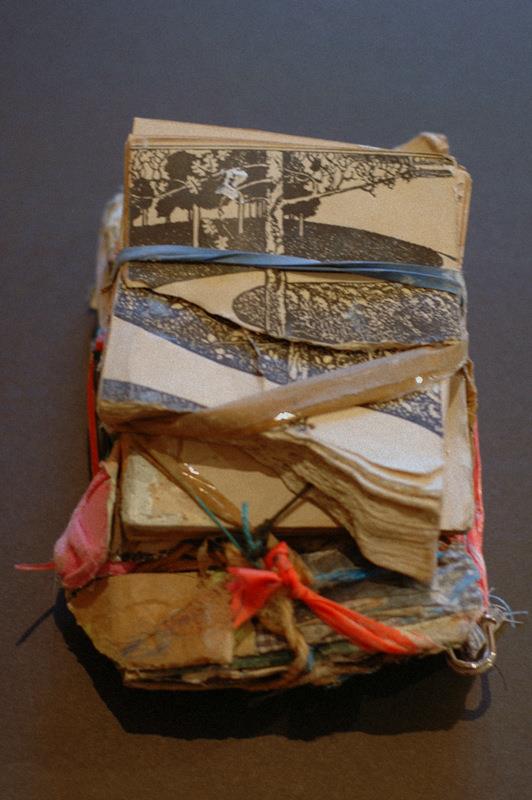
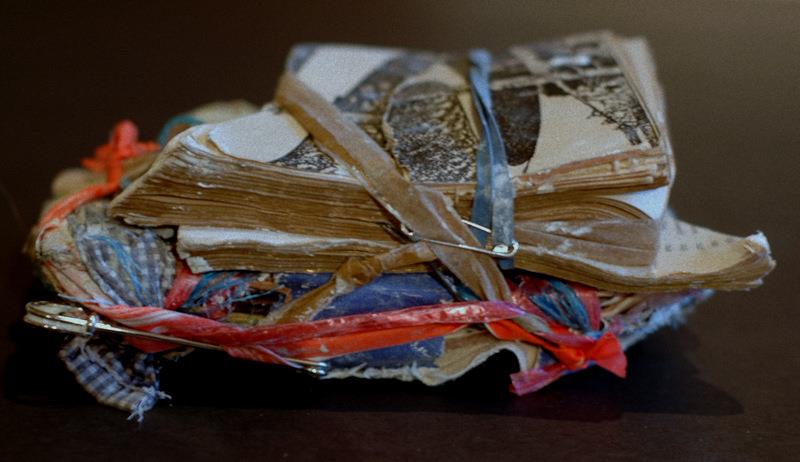
This autumn, I began using the sculptural approach I had been using to rework the supports of paintings to make works using books. I am still interested in pursuing this question, as I conceived of a project involving books as supports about ten years ago, and I like to work elliptically, to come back to an idea years after making the first sketches for it.
2. What’s the last show you saw?
Traces at the AGGV, though by the time you read this, perhaps the Blue Republic show opening at Deluge this Friday (Jan 25th)?
3. What’s the last show that surprised you, and why?
Last summer, I was in Seattle with my daughter Mia and they had an exhibition of contemporary Australian aboriginal art at the Seattle Art Museum; I am familiar with their collection and recalled that they had a terrific piece by Gloria Petyarre [Gloria Petyarre, Leaves, 2002]. The power of the show as a whole really was remarkable, particularly, I guess, because I had been in this pedagogical framework of walking Mia through the more familiar 20th-century Pop and Minimal and contemporary works on that floor, and this work was just so disarmingly strong and centred by comparison. So many of the dialogues we had been having with the other [Pop & minimalist] works were about deflection or deference, whereas these located a centre for themselves in a way that really exposed the insecurity of so much of the art-making enterprise.
4. What’s your favourite place to see art?
Context is so important, and wonderful experiences come from seeing work in contextually rich situations. Studio visits, obviously are a big part of this. I think we value the studio and the street because they are areas in which what we are seeing might or might not be art, and there is this searching after experience that comes with the encounter.
5. How much time per week do you devote to your practice?
I’m not sure. A lot of the time happens in away that (perhaps not surprisingly) is parasitic or symbiotic to other activities, or almost a kind of sleepwalking from one kind of domestic activity into another, and in that space you are making work. I try to find space every day, and am frustrated when this does not happen.
6. What’s the most indispensable item in your studio?
Well, the floor is important. The way things fall to the floor or are found on the floor is a form of restraint and extension that is tremendously useful for me. The things that are close to one’s feet, the way things announce themselves or lay low in the corner of a room, or come up to meet you on a walk. Giacometti said his studio was “two feet” and I understand that. The floor has a kind of aesthetic as well, the aesthetic of “eventually…”
7. Do you collect anything?
Collect and use and wear out/pass on: clothes, books, papers and cordage. I really like to go look for things two or three times a week if I can. The collection is not stable. I wear things out very quickly, am very hard on things; and things get lost, or lent.
8. What’s your art world pet-peeve?
What a tough question to address. Whose or which world I wonder? I’m not sure if I want to make pets of these things! Very dangerous for artists… Sometimes the only way I can make work is to imagine that there is no one, no one that will ever want to see this work. But then, it is very productive, very conducive to studio work for me to have a show lined up. What concerns me is that there is a perception of an art world now that can be approached on a very shallow level, and this is seen as excusable because of the nature of the interface (online), but that this is so far from the really interesting interactions you want to have with creative people. Some of these experiences could happen online, or have representation online, but I miss the weather. Watching money is not the same as watching the weather.
9. Who are one or two people who have been most significant to you in your development as an artist?
Joseph Beuys was very important, but as a complex of sorts with Paul Celan. Francis Bacon and Alberto Giacommetti also came to me as a pair, as did Cage and Johns. My mother made me understand the starkness of art, the way it brooked no compliance with mendacity. Wendy Welch and [my wife] Julie both could see work and understand if it was or was not working right away, without the discussion. I’ve always had to talk through my apparatus.
10. On a scale of 1 to 10, how would you gauge your level of ambition as an artist?
I am not sure what to compare it with. Ambition seems so connected to other drives. I guess as you age you find other outlets for this vitalism, so the Faustian character of your ambition dries up. But the work pushes out across the room. So now I am not really ambitious, but being led around by the work, being tugged around by it, and I have not really solved the problem of how this relationship metastasizes (or lays dormant) in the world.
11. What are one or two factors that, when they’re in place, enable you to really flourish artistically?
Domestic traffic and dead time.
12. What are one or two factors that make it more difficult for you to flourish?
Obligations and anxiety.
13. What are one or two primary areas of fear for you as an artist?
Violence inhering in the process, waiting around to be catalyzed; the way work pulls you away from everything, or directs you towards the place in life where things are mended and divided…The seriousness of it.
14. What is your next challenge?
I think the next challenge is also always the immediate challenge. Which I think in this case relates to trying to get closer to the vocalizing of the work now. Asking the right questions so as to determine how to find an appropriate venue, and understanding timing in this respect.


https://www.davismuseum.com/art-collection.html
JOHN LUNA
(Victoria, Canada, 1971)
The three quarters (grass book), 2012. Oil, latex enamel, spackle and pencil crayon on fragment of untitled hard-edged oil on canvas painting (ca. 1974), stencilled fabric anarchist patch (ca. 2011), illustrated book and papier-mâché, with twine, elastic, cord, leather and pins. Approx. 6″ x 4.3″ x 4″.
Date of donation: November 9, 2012
Inventory number: BLT213

[A very brief background on Mark Rothko to accompany recent productions of John Logan’s play RED in Victoria and Manitoba in 2012:]
Reviews of RED cite its success at coming to terms with the challenging task of staging a play about a visual artist. The devices of theatre – tension and expectation, the palpable, sympathetic resonance of figures on a stage- seem irreconcilable to the quiet contemplation of flat objects on museum walls. And yet it is these qualities that Mark Rothko felt compelled to capture in painting. Dramatic yet vulnerable, eloquent yet obscure; these words describe the artist but also perhaps, his work.
Who was Rothko? He was born Marcus Rothkowitz in what is today Latvia, in 1905, to a family of industrious middle-class Jewish intellectuals who immigrated to the United States eight years later. Marcus proved an able student, earning a scholarship to Yale, but found its elitism alienating and moved to New York, where, thanks to a friend at the Art Students League, he decided to become a painter. Like many Americans of his generation, Rothko’s artistic education was prodigal; during the Depression years, artists of any stripe struggled to survive. At the same time, the Museums of Modern Art (1929) and Non-Objective Painting (later the Guggenheim, 1939) exhibited experimental Europeans like Picasso and Matisse. Getting by teaching children’s art classes, Rothko educated himself in museums and galleries, meeting mentors like Arshile Gorky and Max Weber, immigrants themselves with polyglot passions.
Rothko also worked as an artist for the WPA, a New Deal labor program, alongside notables like Willem de Kooning, Jackson Pollock, Ad Reinhardt, Louise Nevelson and Milton Avery. Many of these artists would go on to develop a style called Abstract Expressionism, emphasizing spontaneous brushwork and intuitive symbolism. They were influenced by the European Surrealists, who used elements of chance (such as “automatic writing”) to liberate the unconscious, producing unexpected images with mythological and political overtones. Rothko, who had studied the psychoanalytic theories of Carl Jung, made connections between ‘primitive’ art and the art of children, in which free colour was the primary impulse.
After the war, the United States emerged as a superpower eager to prove that American culture was more bold, expansive and democratic than any that had come before. The Abstract Expressionists – whose approach to painting emphasized individuality, scale and physical energy – fit the bill. Rothko received his first significant praise from critic Harold Rosenberg, who coined the term, “Action Painting” to describe the way artists enacted conflict within the “arena” of the canvas. As both a Jewish artist haunted by the Holocaust and an avid reader of Shakespeare and Orestes, Rothko wanted to relate the catastrophes of contemporary life to an art that was “tragic and timeless.” Rather than tell stories, Rothko’s canvasses offered a testament to tension and anxiety, resolution and ecstatic calm.
Rothko crafted softly luminous surfaces, displayed without frames to encourage communion with the viewer, whom the artist hoped would feel “enveloped into” a paradoxical combination of intimacy and awe, at tantalizing proximity to “an unknown space.” For a painter interested in intangibles, Rothko’s method was nothing if not physical: pigment solution scrubbed into raw canvas, followed by scumbled skeins of overlapping brushwork; glancing and staining, burning and occluding. The paintings unfold in perception, yielding up structure to time and light. They are absorbing but also moving, a reaction Rothko sought when he described painting as a “religious experience” he wanted to share.
By the mid-1950’s Rothko’s work sold to notable collectors, skyrocketing in value. Success was isolating: stung by the scorn of less successful peers, Rothko also feared that his intentions went unrecognized by collectors who enjoyed his work as decorative. In 1958, the Seagram Company completed their architecturally significant headquarters on Park Avenue and commissioned Rothko to make paintings for the building’s luxury restaurant, The Four Seasons. Rothko was uneasy with making artwork for the enjoyment of wealthy diners, but the opportunity to produce paintings for a dedicated interior proved irresistible. For years, he had wanted to make a grand statement, a “place” that went beyond the effects of any single work.
Rothko designed horizontal compositions suggestive of architecture: columns, doors or windows. He travelled to Europe: the reds of Pompeii’s Villa of the Mysteries influenced his palette; while in Florence, the murals at Michelangelo’s Laurentian Library inspired visions of a space in which “all the doors and windows are bricked up.” In selecting these precedents, Rothko sought to measure himself against the European tradition, but also to come to grips with his conflicted ambivalence. The outcome of this struggle, between ego and integrity, ambition and authenticity, plays out in the closing scenes of RED.
A recent preview for Galleries West of Tara Nicholson’s exhibition at Deluge Contemporary.
Here are two articles based on my interview with Diane Carr at the end of August 2012:
 A recent reviw of Robert Youds’ show at Deluge Contemporary via Canadian Art. Thanks to Leah Sandals for editing and links.
 John Luna