A questionnaire from Michael Jess (Decoupage Publications), January 2013

1. What project are you working on now?

This autumn, I began using the sculptural approach I had been using to rework the supports of paintings to make works using books. I am still interested in pursuing this question, as I conceived of a project involving books as supports about ten years ago, and I like to work elliptically, to come back to an idea years after making the first sketches for it.

2. What’s the last show you saw?

Traces at the AGGV, though by the time you read this, perhaps the Blue Republic show opening at Deluge this Friday (Jan 25th)?

3. What’s the last show that surprised you, and why?

Last summer, I was in Seattle with my daughter Mia and they had an exhibition of contemporary Australian aboriginal art at the Seattle Art Museum; I am familiar with their collection and recalled that they had a terrific piece by Gloria Petyarre [Gloria Petyarre, Leaves, 2002]. The power of the show as a whole really was remarkable, particularly, I guess, because I had been in this pedagogical framework of walking Mia through the more familiar 20th-century Pop and Minimal and contemporary works on that floor, and this work was just so disarmingly strong and centred by comparison. So many of the dialogues we had been having with the other [Pop & minimalist] works were about deflection or deference, whereas these located a centre for themselves in a way that really exposed the insecurity of so much of the art-making enterprise.

4. What’s your favourite place to see art?

Context is so important, and wonderful experiences come from seeing work in contextually rich situations. Studio visits, obviously are a big part of this. I think we value the studio and the street because they are areas in which what we are seeing might or might not be art, and there is this searching after experience that comes with the encounter.

5. How much time per week do you devote to your practice?

I’m not sure. A lot of the time happens in away that (perhaps not surprisingly) is parasitic or symbiotic to other activities, or almost a kind of sleepwalking from one kind of domestic activity into another, and in that space you are making work. I try to find space every day, and am frustrated when this does not happen.

6. What’s the most indispensable item in your studio?

Well, the floor is important. The way things fall to the floor or are found on the floor is a form of restraint and extension that is tremendously useful for me. The things that are close to one’s feet, the way things announce themselves or lay low in the corner of a room, or come up to meet you on a walk. Giacometti said his studio was “two feet” and I understand that. The floor has a kind of aesthetic as well, the aesthetic of “eventually…”

7. Do you collect anything?

Collect and use and wear out/pass on: clothes, books, papers and cordage. I really like to go look for things two or three times a week if I can. The collection is not stable. I wear things out very quickly, am very hard on things; and things get lost, or lent.

8. What’s your art world pet-peeve?

What a tough question to address. Whose or which world I wonder? I’m not sure if I want to make pets of these things! Very dangerous for artists… Sometimes the only way I can make work is to imagine that there is no one, no one that will ever want to see this work. But then, it is very productive, very conducive to studio work for me to have a show lined up. What concerns me is that there is a perception of an art world now that can be approached on a very shallow level, and this is seen as excusable because of the nature of the interface (online), but that this is so far from the really interesting interactions you want to have with creative people. Some of these experiences could happen online, or have representation online, but I miss the weather. Watching money is not the same as watching the weather.

9. Who are one or two people who have been most significant to you in your development as an artist?

Joseph Beuys was very important, but as a complex of sorts with Paul Celan. Francis Bacon and Alberto Giacommetti also came to me as a pair, as did Cage and Johns. My mother made me understand the starkness of art, the way it brooked no compliance with mendacity. Wendy Welch and [my wife] Julie both could see work and understand if it was or was not working right away, without the discussion. I’ve always had to talk through my apparatus.

10. On a scale of 1 to 10, how would you gauge your level of ambition as an artist?

I am not sure what to compare it with. Ambition seems so connected to other drives. I guess as you age you find other outlets for this vitalism, so the Faustian character of your ambition dries up. But the work pushes out across the room. So now I am not really ambitious, but being led around by the work, being tugged around by it, and I have not really solved the problem of how this relationship metastasizes (or lays dormant) in the world.

11. What are one or two factors that, when they’re in place, enable you to really flourish artistically?

Domestic traffic and dead time.

12. What are one or two factors that make it more difficult for you to flourish?

Obligations and anxiety.

13. What are one or two primary areas of fear for you as an artist?

Violence inhering in the process, waiting around to be catalyzed; the way work pulls you away from everything, or directs you towards the place in life where things are mended and divided…The seriousness of it.

14. What is your next challenge?

I think the next challenge is also always the immediate challenge. Which I think in this case relates to trying to get closer to the vocalizing of the work now. Asking the right questions so as to determine how to find an appropriate venue, and understanding timing in this respect.
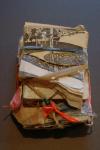
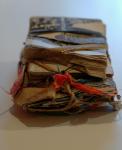
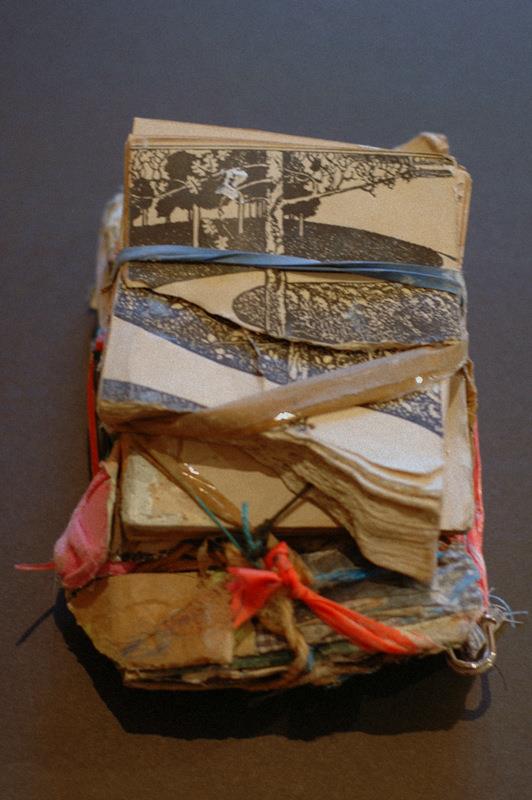
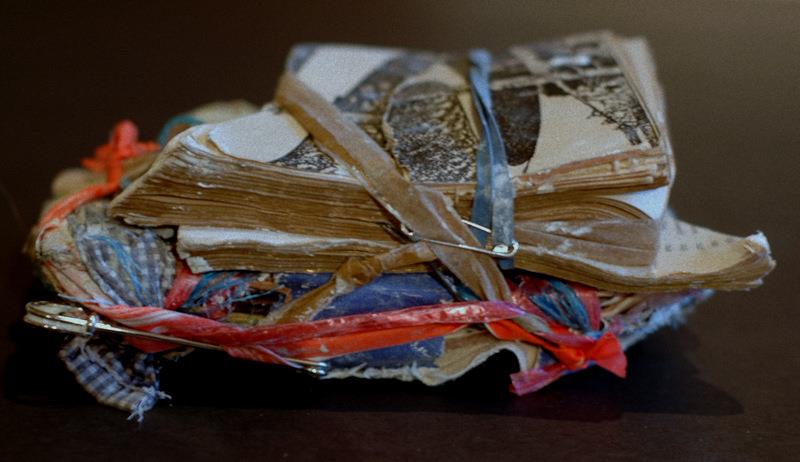
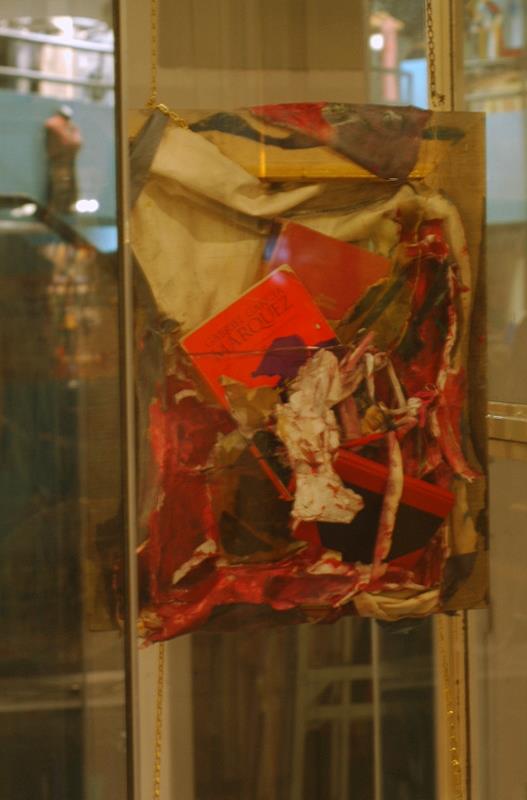
The three quarters (grass book), 2012

Gallery
Info
Comments
  • The three quarters (grass book), 2012. Oil, latex enamel, spackle and pencil crayon on fragment of untitled hard-edged oil on canvas painting (ca. 1974), stencilled fabric anarchist patch (ca. 2011), illustrated book and papier-mâché, with twine, elastic, cord, leather and pins. Approx. 6″ x 4.3″ x 4″. Collection of the Davis Museum, Barcelona

    https://www.davismuseum.com/art-collection.html

    JOHN LUNA

    (Victoria, Canada, 1971)
    The three quarters (grass book), 2012. Oil, latex enamel, spackle and pencil crayon on fragment of untitled hard-edged oil on canvas painting (ca. 1974), stencilled fabric anarchist patch (ca. 2011), illustrated book and papier-mâché, with twine, elastic, cord, leather and pins. Approx. 6″ x 4.3″ x 4″.
    Date of donation: November 9, 2012
    Inventory number: BLT213

Rothko and RED [2012]

mark rothko untitled (section 3) 1959_0

[A very brief background on Mark Rothko to accompany recent productions of John Logan’s play RED in Victoria and Manitoba in 2012:]

Reviews of RED cite its success at coming to terms with the challenging task of staging a play about a visual artist. The devices of theatre – tension and expectation, the palpable, sympathetic resonance of figures on a stage- seem irreconcilable to the quiet contemplation of flat objects on museum walls. And yet it is these qualities that Mark Rothko felt compelled to capture in painting. Dramatic yet vulnerable, eloquent yet obscure; these words describe the artist but also perhaps, his work.

Who was Rothko? He was born Marcus Rothkowitz in what is today Latvia, in 1905, to a family of industrious middle-class Jewish intellectuals who immigrated to the United States eight years later. Marcus proved an able student, earning a scholarship to Yale, but found its elitism alienating and moved to New York, where, thanks to a friend at the Art Students League, he decided to become a painter. Like many Americans of his generation, Rothko’s artistic education was prodigal; during the Depression years, artists of any stripe struggled to survive. At the same time, the Museums of Modern Art (1929) and Non-Objective Painting (later the Guggenheim, 1939) exhibited experimental Europeans like Picasso and Matisse. Getting by teaching children’s art classes, Rothko educated himself in museums and galleries, meeting mentors like Arshile Gorky and Max Weber, immigrants themselves with polyglot passions.

Rothko also worked as an artist for the WPA, a New Deal labor program, alongside notables like Willem de Kooning, Jackson Pollock, Ad Reinhardt, Louise Nevelson and Milton Avery. Many of these artists would go on to develop a style called Abstract Expressionism, emphasizing spontaneous brushwork and intuitive symbolism. They were influenced by the European Surrealists, who used elements of chance (such as “automatic writing”) to liberate the unconscious, producing unexpected images with mythological and political overtones. Rothko, who had studied the psychoanalytic theories of Carl Jung, made connections between ‘primitive’ art and the art of children, in which free colour was the primary impulse.

After the war, the United States emerged as a superpower eager to prove that American culture was more bold, expansive and democratic than any that had come before. The Abstract Expressionists – whose approach to painting emphasized individuality, scale and physical energy – fit the bill. Rothko received his first significant praise from critic Harold Rosenberg, who coined the term, “Action Painting” to describe the way artists enacted conflict within the “arena” of the canvas. As both a Jewish artist haunted by the Holocaust and an avid reader of Shakespeare and Orestes, Rothko wanted to relate the catastrophes of contemporary life to an art that was “tragic and timeless.” Rather than tell stories, Rothko’s canvasses offered a testament to tension and anxiety, resolution and ecstatic calm.

Rothko crafted softly luminous surfaces, displayed without frames to encourage communion with the viewer, whom the artist hoped would feel “enveloped into” a paradoxical combination of intimacy and awe, at tantalizing proximity to “an unknown space.” For a painter interested in intangibles, Rothko’s method was nothing if not physical: pigment solution scrubbed into raw canvas, followed by scumbled skeins of overlapping brushwork; glancing and staining, burning and occluding. The paintings unfold in perception, yielding up structure to time and light. They are absorbing but also moving, a reaction Rothko sought when he described painting as a “religious experience” he wanted to share.

By the mid-1950’s Rothko’s work sold to notable collectors, skyrocketing in value. Success was isolating: stung by the scorn of less successful peers, Rothko also feared that his intentions went unrecognized by collectors who enjoyed his work as decorative. In 1958, the Seagram Company completed their architecturally significant headquarters on Park Avenue and commissioned Rothko to make paintings for the building’s luxury restaurant, The Four Seasons. Rothko was uneasy with making artwork for the enjoyment of wealthy diners, but the opportunity to produce paintings for a dedicated interior proved irresistible. For years, he had wanted to make a grand statement, a “place” that went beyond the effects of any single work.

Rothko designed horizontal compositions suggestive of architecture: columns, doors or windows. He travelled to Europe: the reds of Pompeii’s Villa of the Mysteries influenced his palette; while in Florence, the murals at Michelangelo’s Laurentian Library inspired visions of a space in which “all the doors and windows are bricked up.” In selecting these precedents, Rothko sought to measure himself against the European tradition, but also to come to grips with his conflicted ambivalence. The outcome of this struggle, between ego and integrity, ambition and authenticity, plays out in the closing scenes of RED.

Interview with Ira Hoffecker, 2011

[the following interview was conducted by email on November 27th, 2011]

IH: How is your early work different to your recent work?

JL: I am going to interpret ‘early’ as the work I exhibited between 2001 and 2006, that is, before I began integrating paper sculpture into the pieces, and generally exploring installation more aggressively in exhibiting formats. Of course, this qualifier begins to address your question as well. My earlier work was still fundamentally involved with the 2-dimensional rectangle as the working proposition for beginning painting. Many of the things that began to happen in the work exhibited in Paintings and Objects (2006) represented the limits of this approach, including canvasses that had been excessively scraped down and often re-stretched multiple times in the course of their development, paintings developed over much older work, paintings left pointedly incomplete, and canvasses unframed and suspended from the ceiling (see examples like Torso of JDR/JL, and Leaves on my website.) In many of these works, I felt like I was exhausting the ability of the painting as surface to convey meaning, and identifying more with the expressive potential of the painting as object. Not an object that dramatically staged its own physical integrity (what Michael Fried called “objecthood”) but an object that arrives as the outcome of a bundle of physical processes one enacts on the painting as a whole (scraping down, stretching, hanging, etc.), carried out to an extreme that threatens to dismay this integrity rather than preserve or enforce it. 2006 Was also the point at which I played with temporary or fugitive sculptural pieces that addressed the studio environment in a sort of meta-narrative (Everything I Can Remember/ Anyone I’ve Forgotten, Undrawing…)

IH: You don’t confine yourself to a canvas. What compels you to go beyond the flat surface?

JL: See above. As for the choice of paper as a primary sculpture material, see below.

IH: How do you think of the relation of text (the books) and the materials used in your artwork?

JL: I’ve been working with paper since about 2007. Some of that history is outlined in the answers I sent to you in a previous exchange. Books are a little different, but it is important to me that the share a certain frangibility with the papier-mâché, in part because the dichotomy of the integrity of objects vs. the making/unmaking of process is also visible in old books, which are both physically degrading and losing their meaning (at least their meaning as stable
composites.) So there is an aspect of entropy at work in both painting and books, or another word I’m attracted to decreation. I’m stealing this term from the poet Anne Carson who stole it from Simone Weil*, but essentially the idea of breaking down structures to allow for a greater, overriding force to take control. This can seem to be elegiac (a loss of painting, a loss of as book’s social coherence), and I accept responsibility for that reading, but in the end I’m more interested in a de-centred work than in a work about something being annihilated. I find it useful to think of the works with books as still-life painting (from Dutch examples like Kalf to the American like John Frederick Peto, who painted distressed papers and books). In that very explicit tradition of still-life painting, the painting itself competes with the object (one threatens to replace the need for the other) and they achieve a kind of parity that allows the painting to escape the usual conventions (of telling, of rendering), that are so much a part of trompe l’oeil painting. I would argue that this same character is present albeit differently, in the still-life work of Morandi or Cezanne. This notion is supported by Siri Hustvedt’s excellent essay on still life, “Ghosts at the Table.” Paint on some level acquires the intractability of the objects its being asked to resemble, and the objects in turn assume the morphological mobility of paint. As Tuymans says “everything becomes painting.”

IH: How would you describe your relationship to narrative?

JL: See above.

IH: When you begin a painting/piece do you always know from the start what you want to paint? Are you a conceptual artist?

JL: I’m not sure if I should assume that these questions naturally follow on one another. The answer to the first question is an unequivocal no. There are flashes, intimations, an attraction to other things that all resemble and inform the work, and I make many drawings as I go that only much later become relevant. The work is ever ahead of me. As for ‘conceptual’, no. Only because I have so much trouble qualifying the term. Clearly, work as thought interests me,
but like old-school abstract painters who rejected the term ‘abstract’ on the grounds that it smacked of an intellectualization of art making, I’ve never been comfortable with that label. And I really don’t like to begin with a fixed plan that could be conceptualized. I like to start with a shopping list (of ideas or materials… there is no point in separating those words.)

IH: What emotions do you have when you are creating?

JL: I don’t think I can answer that readily. The line separating sensation and emotion becomes quite fine, as it should be, and I reflect much too quickly to retain what I’ve reflected upon. The ‘afterglow’ phase of a good studio session offers all kinds of emotional residue, but again I’d hate to describe them as emotions when really they are complexes of sensation, feeling and reflection.

IH: When you go in to start a new painting, how do you begin?

JL: with a material response. The support is still the beginning and the end of all working. This may eventually change, but for now I cling to that idea (learned from something Braque wrote. It may be in his “Studio Notes” in Herschel Chipp’s Theories of Modern Art.)

IH: What is your relation to colour?

JL: I don’t have a lucid sense of colour harmonies like others (my mother, my wife) do. It’s mostly had to be learned. Colour is a way of recording decisions (the red decision preceded the green one, etc.), so that in effect a bruise coloured patina becomes a register of time spent. In this sense, I’ve sometimes made work without colour, relying instead on texture, sheen and other markers.

IH: Which of your exhibitions was your favourite one so far and why?

JL: Hard to say, because there are always things one would have had turn out better. Probably either 0110 or Paper Palace (with Wendy Welch), because in both of those cases, the work stretched out towards something new; I was able to work through the outcomes for years after. Both also provoked the most satisfying responses in terms of viewers’ comments and reviews.

IH: Which books influenced your work most?

JL: Such a difficult question to answer! Certainly Rosalind E. Krauss & Yve-Alain Bois’ Formless: A User’s Guide (Zone: 2000); also James Elkins’ What Painting Is (Routledge, 2000.) But other things (poetry by Celan, Vallejo, John Ashberry or Hart Crane, for instance) were essential as well in other ways.

IH: Who are some of the artists working now who you like or are influenced by?

JL: Influence is physical and viral and impossible to avoid, outside of not looking at work. Without meaning to I’ve been influenced by friends (Wendy, for instance) as well as dead artists like Francis Bacon or Giacometti. I think you have to be actively looking, or your influences acquire a default character. Just now I don’t feel any strong influences that I’m aware of, though I admire plenty of artists (Arturo Herrera recently, or Elizabeth Murray.) I’ve spent many months consciously looking at Johns without feeling I’ve learned enough, and
Twombly’s sculpture continues to interest me too. I was presented with a catalogue of Richard Serra’s drawings last summer that I am living with now, and recently found myself addressing something he’d said about weight (an important idea for me) in a piece of writing, so that’s an influence. But then that writing was about Emily Dickinson…

IH: Does the artist have a political responsibility?

JL: Yes, but its best manifestation is not always explicit.

IH: I love your variety of titling strategies. At what point do the titles arrive for you, and what function do they perform?

JL: It’s a struggle. I’m still trying to understand how the dialogic character of a painting (or whatever) might come across in a title. So far I’ve encountered a certain amount of brittleness and instability in the ways I’ve gone about it. My means of exhibition need to mature, and then I hope so will the titles along with them.

IH: Do you have favorite pieces of art?

JL: I’m not sure. The relationship is generally remote (as in Bacon having several postcard copies of Velazquez’s Pope Innocent X around his studio.) I like a lot of things by Matisse, Kiefer, Murray, Johns, Rauschenberg, Tintoretto, Rembrandt, Leon Kossoff, etc. I’m not sure if I currently have an ‘impossible’ painting (the kind of work you just return to and marvel, and contest and measure by without getting to the end of it) but certainly it’s a good idea,
especially when still a student.

IH: Which artists are most influential on you?

Maybe some of those listed above. But sometimes it’s just the idea of the artist also, I admit. But none of those mentioned above are by accident. I once had a job in a factory operating vacuum presses, and labeled all of them with different artist’s names: Auerbach, Friedrich, etc.

IH: What are you working on right now?

JL: Just a couple of pieces of work which in fact feel quite conservative to me. I have some drawings for more ambitious things that are closer to sculpture (seemingly like late Stella or Judy Pfaff), but I really can’t say when those will start. Sometimes it is years between drawing and real development, and I’m still just camping in my new studio.

* See, for instance, “Anne Carson and the Sublime”, by James Pollock: http://www.cprw.com/Pollock/carson.htm

VISA Faculty Exhibition, 2011

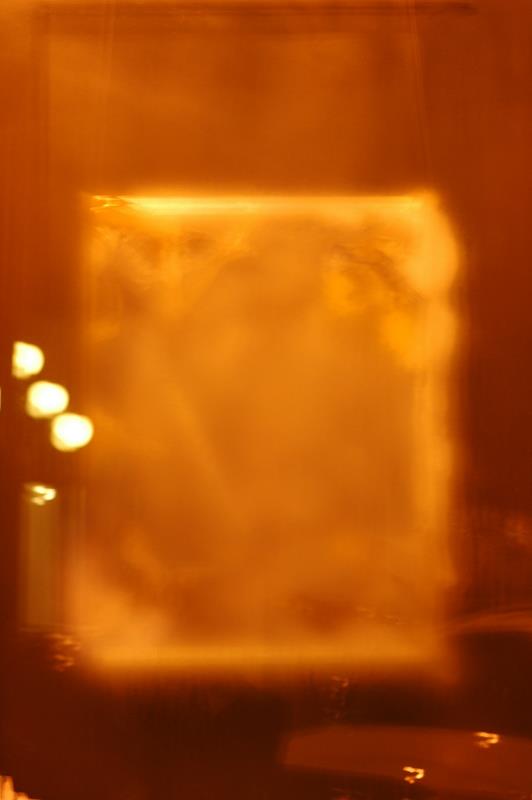
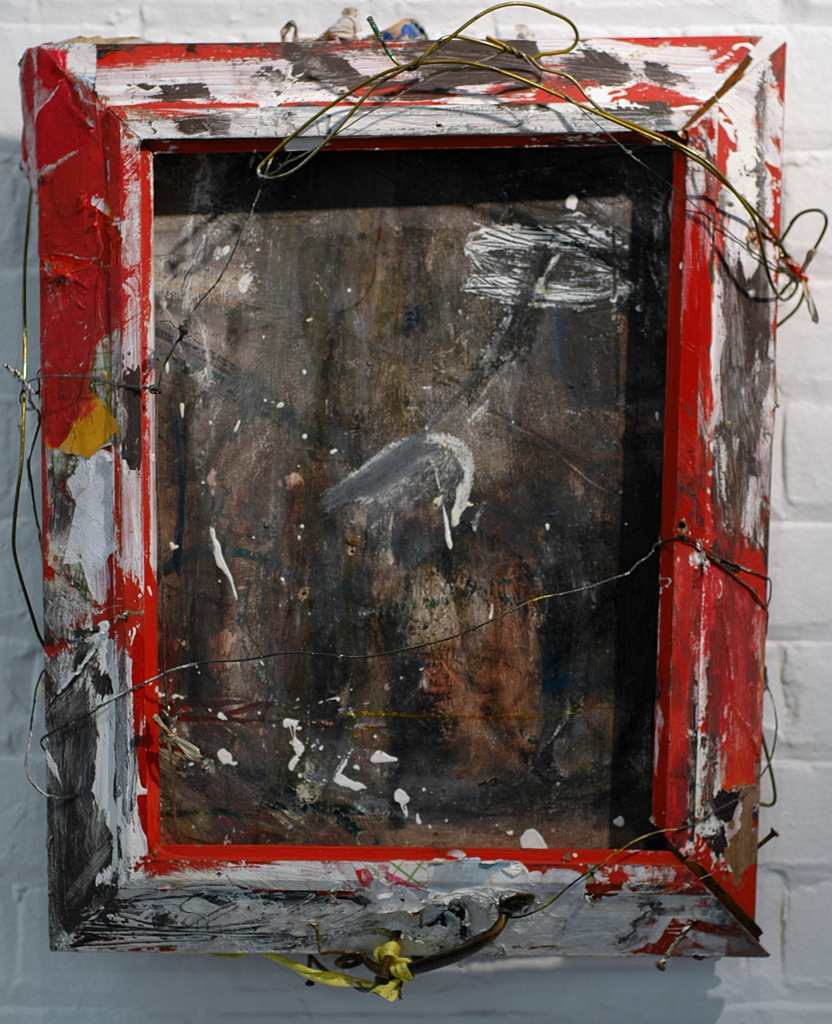
What did you take from them? (The Persian Expedition); Painting for Cy Twombly [front and reverse views] (oil, acrylic, graphite, chalk and charcoal on panel with frame, cloth, wire, bracket and book, approx. 22″ x 16.5″) 2010-2011 [exhibited at VISA Faculty Exhibition, 2011]

Sounds in a Room 4 (June 2011, Vancouver Island School of Art) – Images and Recording

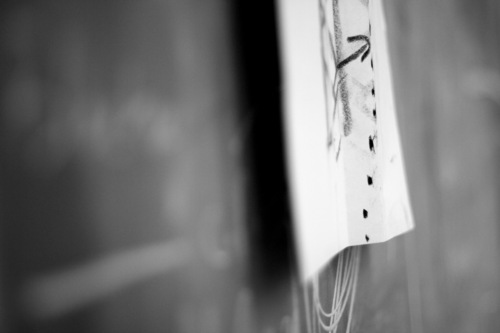
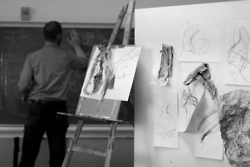
This performance featured artist/teacher John Luna presenting a silent art history lecture in one classroom, and DROUIN/OLSEN in an adjacent classroom creating an improvised electroacoustic parallel to the amplified sounds of Luna’s chalkboard, slide projector, and paper assemblages. See images above and audio recording below.